

 Language
 English
 中文简体
 日本語
 русский
 Español
 عربى

Oct, 06, 2026
Men’s Full-Length SUP Wetsuit: 3mm Neoprene Protection for Comfort, Warmth, and Performance
Introduction
Stand-up paddleboarding combines balance, movement, and exposure to changing water conditions. Even during mild weather, paddlers may encounter cold water, wind chill, splashes, unexpected falls, and long periods of cooling caused by wet clothing. The right wetsuit is therefore more than a basic layer. It must help retain body heat, allow unrestricted movement, withstand repeated contact with equipment, and remain comfortable throughout an active session.
The Men’s Full-Length SUP Wetsuit is designed to address these needs with a practical combination of 3mm nylon-laminated CR neoprene, a one-piece full-length structure, blind-stitched and GBS seam construction, a fine embossed chest panel, reinforced knee pads, and a secure back-entry closure system. Its design is focused specifically on the demands of stand-up paddleboarding while remaining suitable for kayaking, canoeing, surfing, open-water training, and other recreational water activities.
Manufactured by Jiangsu Yiheng Sports Products Co., Ltd., the wetsuit reflects the capabilities of a specialized neoprene manufacturer with more than 18 years of industry experience. The company operates a factory of more than 15,000 square meters and employs over 120 professional workers. Its experience covers both neoprene fabric production and finished water-sports products, allowing it to manage the relationship between raw materials, pattern development, construction, quality control, and finished-product performance.
This article examines the product’s construction, functional advantages, manufacturing strengths, quality considerations, customization potential, and suitability for distributors, retailers, water-sports brands, and end users.
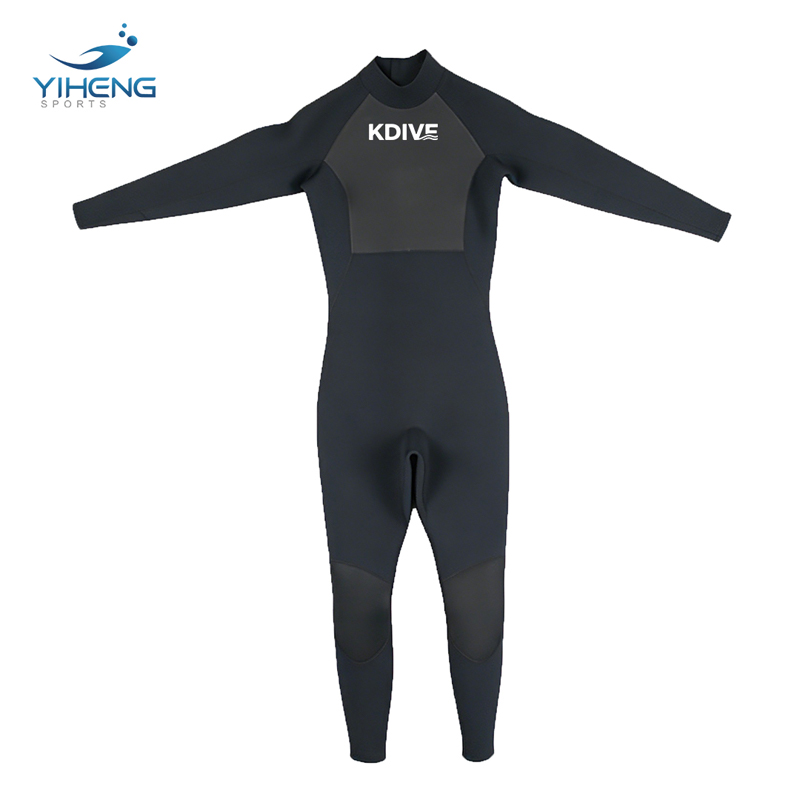
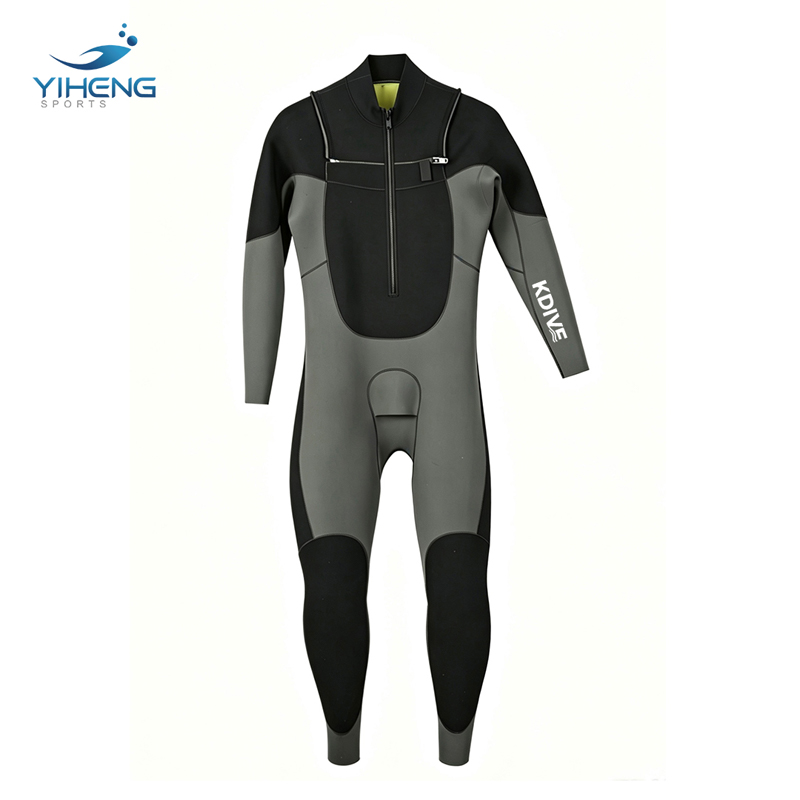
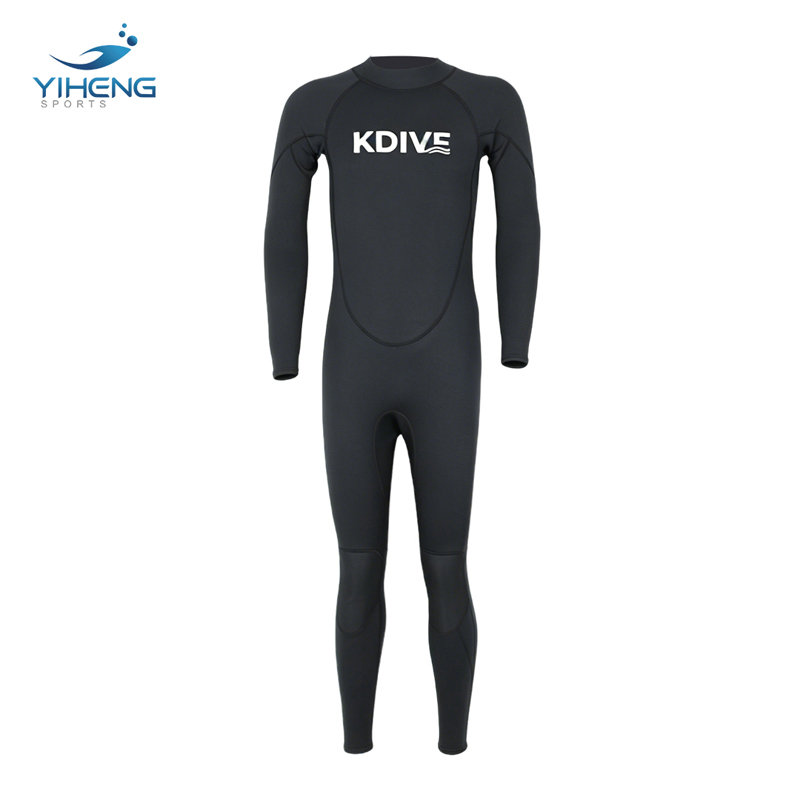
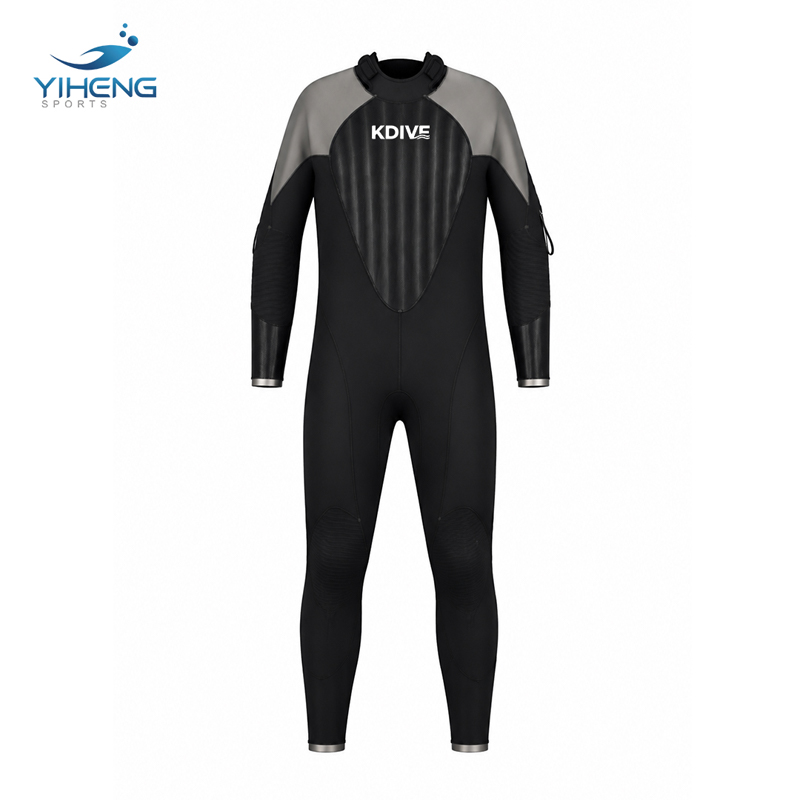
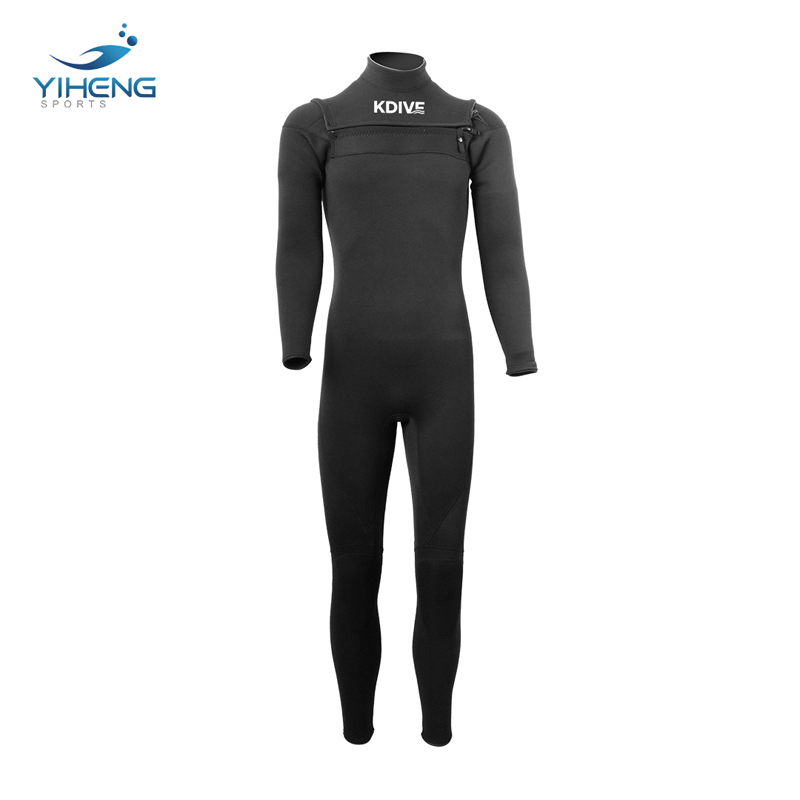
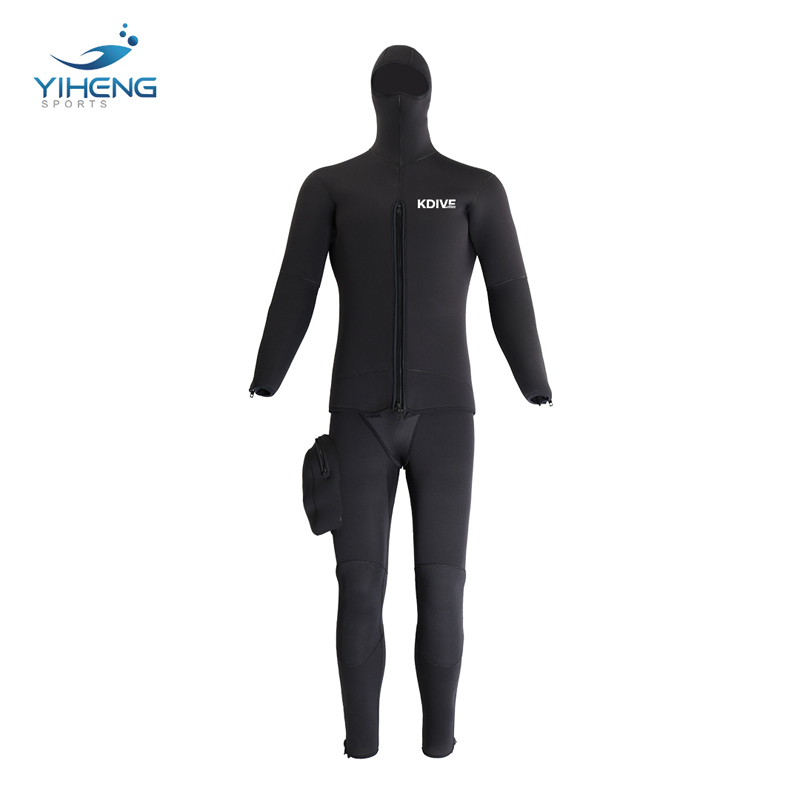
Men's Full Length SUP Wetsuit
Product Overview
The Men’s Full-Length SUP Wetsuit is a one-piece suit created for men who need full-body coverage during paddleboarding and other water activities. It is made from a three-layer material structure consisting of nylon, neoprene, and nylon. The central neoprene layer provides thermal insulation and flexibility, while the nylon outer and inner surfaces support durability, comfort, and easier handling.
| Product Feature | Specification | Functional Benefit |
|---|---|---|
| Product type | Men’s full-length SUP wetsuit | Provides coverage for the torso, arms, and legs |
| Material | Nylon + neoprene + nylon | Balances warmth, flexibility, comfort, and durability |
| Thickness | 3mm | Offers a practical balance between thermal protection and mobility |
| Construction | GBS and blind-stitched seam construction | Helps reduce water penetration through seam lines |
| Entry system | Back YKK zipper with extended pull tab | Supports convenient dressing and removal |
| Collar | Adjustable hook-and-loop closure | Creates a more secure neck fit and helps limit water entry |
| Chest design | Fine embossed chest panel | Improves surface friction and helps reduce wind chill |
| Knee protection | Reinforced knee pads | Improves durability in high-contact areas |
| Available sizes | S, M, L, XL, XXL, XXXL | Supports a broad range of adult users |
| Color | Black | Creates a versatile appearance suitable for retail collections |
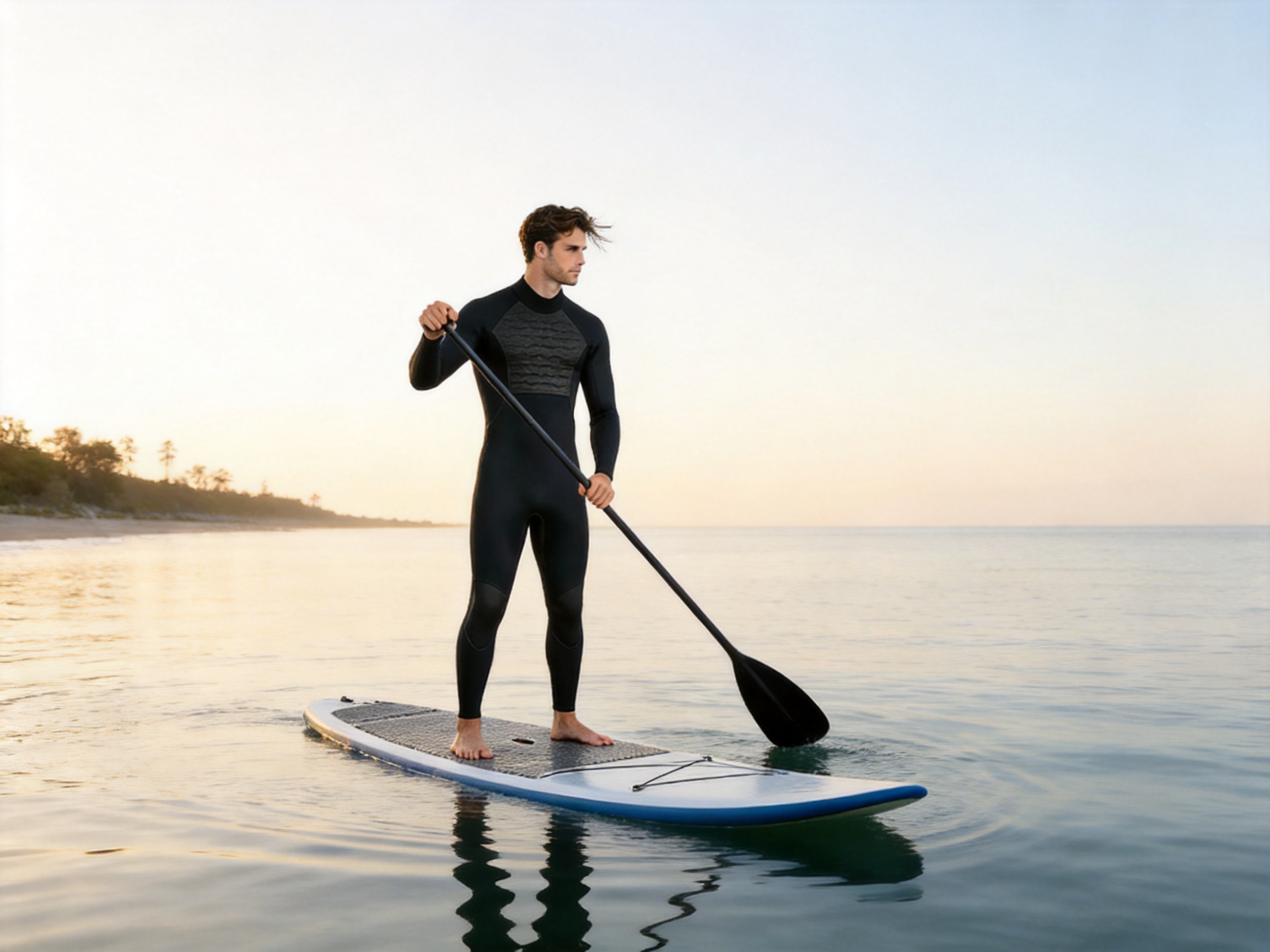
The product’s full-length design is particularly useful for SUP users because paddleboarding often involves kneeling, sitting, standing, and recovering balance. These movements expose the knees, elbows, torso, and legs to water, wind, board surfaces, and repeated friction. A short wetsuit may provide less protection in these situations, while a full-length suit delivers more complete coverage without requiring several separate garments.
3mm Neoprene for Balanced Thermal Performance
Neoprene thickness has a direct influence on warmth, flexibility, weight, and comfort. A thicker suit may provide additional insulation, but it can also feel heavier and restrict movement. A thinner suit may improve mobility but offer less protection in cooler water. The 3mm thickness used in this SUP wetsuit is intended to provide a balanced solution for users who need thermal support while maintaining the freedom to paddle, rotate the shoulders, bend the knees, and adjust their stance.
The neoprene core works by trapping a layer of air within its cellular structure. When used correctly, this structure helps slow the transfer of body heat into the surrounding water and air. The outer nylon layer helps protect the neoprene from everyday abrasion, while the inner nylon surface contributes to a smoother wearing experience and supports easier dressing.
For SUP applications, warmth is not determined by thickness alone. Wind exposure, seam construction, collar fit, body coverage, activity level, water temperature, and personal sensitivity all influence comfort. The product combines these factors rather than depending only on a thick neoprene layer. Its fine embossed chest panel helps reduce the cooling effect of wind across the front of the body, and its full-length design protects the limbs as well as the torso.
The three-layer nylon-neoprene-nylon construction also creates a useful platform for private-label development. Different surface fabrics, colors, logos, prints, and pattern adjustments can be evaluated while keeping the core neoprene concept consistent. This is important for brands that require a dependable base product but want to develop a distinct visual identity.
Fine Embossed Chest Panel for Wind and Water Activities
The chest area is one of the most exposed parts of a paddleboarder’s body. When a rider moves forward against wind or remains stationary while balancing on the board, the front torso can experience significant cooling. The fine embossed chest panel is designed to increase surface friction and help reduce wind chill across this important area.
Embossing can also add a more structured surface to the chest without requiring a bulky additional layer. This supports a closer contact between the panel and the surrounding environment while helping the garment maintain its shape. For SUP users, the chest panel may also contribute to a more stable interaction between the upper body and changing airflow during paddling.
Compared with a completely smooth suit, an embossed chest surface can provide a more technical appearance and communicate product functionality to consumers. It may be particularly valuable for retailers seeking a wetsuit that looks purpose-built for paddleboarding rather than adapted from a general-purpose water garment.
The embossed chest design is not intended to replace proper layering or to define a precise water-temperature rating. Instead, it forms part of a coordinated thermal system that includes 3mm neoprene, full-length coverage, seam construction, an adjustable collar, and appropriate fit.
GBS and Blind-Stitched Seam Construction
Seams are among the most important construction areas in a wetsuit. Even a high-quality neoprene panel can provide limited thermal performance if excessive water enters through poorly designed or poorly finished seam lines. The Men’s Full-Length SUP Wetsuit uses GBS and blind-stitched construction to help minimize water penetration and improve durability during repeated use.
GBS, commonly understood as glued and blind-stitched construction, joins neoprene panels through adhesive bonding and stitching that does not pass fully through the material in the same way as a conventional exposed seam. The adhesive helps close the seam line, while blind stitching supports structural integrity without creating unnecessary open pathways through the neoprene.
For paddleboarding, this construction is especially relevant because the suit may be exposed to continuous splashes, kneeling water, falls, and repeated flexing around the shoulders, hips, knees, and lower back. Reduced water entry can help the wearer remain warmer and more comfortable during extended sessions. Carefully finished seams can also reduce the sensation of rough edges against the skin.
Seam construction is one area in which specialized manufacturing experience becomes important. Panel alignment, adhesive application, stitch density, sewing tension, curing conditions, and inspection standards can all influence final performance. A manufacturer that works with neoprene fabrics and finished suits can coordinate these processes more effectively than a supplier focused only on garment assembly.
While no wetsuit should be described as completely waterproof under every condition, the stated construction is intended to minimize water seepage through the seam lines. The product specification reports hydrostatic pressure resistance of at least 80 kPa with no water seepage under the relevant test conditions. Actual performance may vary according to fit, body movement, garment condition, and usage environment.
Reinforced Knee Pads for Paddleboarding Durability
Knees are high-contact areas during paddleboarding. Beginners often kneel while learning to balance, and experienced riders may kneel during turns, rest periods, launches, landings, or recovery after a fall. Contact with the board deck, paddleboard accessories, shore surfaces, and other equipment can gradually create wear in the knee area.
The reinforced knee pads are designed to improve durability where repeated abrasion is most likely to occur. They also provide an additional protective layer between the user and the board surface. This feature is useful for recreational users who may spend extended periods in a kneeling position as well as for instructors, rental operators, and training centers whose equipment experiences frequent use.
Independent product testing specifications report no damage after 4,000 friction cycles under pressure of at least 9 kPa. This performance statement indicates that the reinforced area has been evaluated under controlled abrasion conditions. It should not be interpreted as a guarantee that the suit cannot be cut, punctured, or damaged by sharp objects, rough concrete, hooks, rocks, or improper handling.
The placement of reinforcement is also important. Adding protection only where it is needed helps preserve overall flexibility and avoids making the garment unnecessarily heavy. The combination of a flexible neoprene body and targeted knee reinforcement can provide a more practical design than using thick, rigid material across the entire suit.
Back-Entry YKK Zipper and Adjustable Collar
Putting on a full-length wetsuit can be challenging, especially when the garment must fit closely enough to reduce flushing but remain comfortable during movement. The back-entry system uses a YKK zipper with an extended pull tab to support easier dressing and removal.
A reliable zipper is valuable for both consumer satisfaction and product longevity. The extended pull tab allows the wearer to reach the closure more easily, which can reduce the need for assistance. It also supports faster preparation before a session and easier removal after the activity. For rental businesses or group programs, a straightforward entry system can help simplify equipment turnover.
The adjustable hook-and-loop collar closure allows users to modify the fit around the neck. A secure collar helps reduce the movement of cold water into the suit while avoiding the need for a permanently tight opening. The wearer can make small adjustments according to comfort, layering, and personal preference.
The collar should be closed firmly but comfortably. Excessive tightening may cause discomfort, while insufficient adjustment may allow more water entry. The flexible closure makes the suit more adaptable than a fixed collar design and can be helpful when different users share similar equipment.
Full-Length Coverage and Movement
The one-piece full-length structure covers the arms and legs as well as the torso. This arrangement provides several practical benefits for SUP users. It reduces direct exposure to cold water during falls, protects the legs from board contact, and limits the number of separate garments needed before entering the water.
Full-length coverage can also simplify product selection for consumers. Instead of combining a short wetsuit with separate leggings, sleeves, or thermal layers, users can begin with one coordinated garment. This may reduce bulk around the waist and improve the consistency of thermal protection across the body.
Mobility remains essential. Paddleboarding requires repeated shoulder rotation, elbow flexion, torso rotation, hip movement, and knee bending. The 3mm neoprene construction is intended to support these motions while providing useful insulation. Correct sizing is critical because even a flexible wetsuit may feel restrictive if it is too small, while an oversized suit may create folds, gaps, and unnecessary water circulation.
The available size range of S through XXXL allows retailers and distributors to serve a broad adult customer base. However, size grading should be reviewed according to the manufacturer’s measurement chart before ordering. Body proportions differ, and users should consider chest, waist, hip, inseam, height, and preferred fit rather than relying only on their usual clothing size.
Performance Specifications
The product is supported by several defined performance indicators. These specifications are useful for buyers who need more than general claims about warmth or durability. They also provide a basis for quality-control discussions between manufacturers, brands, distributors, and retailers.
| Test or Feature | Reported Requirement | Practical Meaning |
|---|---|---|
| Abrasion resistance | No damage after 4,000 friction cycles under pressure of at least 9 kPa | Supports durability in repeated-contact areas under controlled testing |
| Hydrostatic resistance | At least 80 kPa with no water seepage under test conditions | Indicates resistance to water penetration through tested material or construction |
| Tensile strength | No breakage after 10 seconds under tension of at least 150 N, lengthwise and crosswise | Supports confidence in material strength in two primary directions |
| Seam construction | GBS and blind stitching | Helps reduce seam-line water entry and supports structural strength |
| Thermal structure | 3mm CR neoprene laminated with nylon | Combines insulation with flexibility and surface durability |
Testing provides a controlled indication of product quality, but it should be considered alongside real-world use factors. Water temperature, wind, activity intensity, body composition, fit, care, UV exposure, storage, and contact with abrasive surfaces all affect service life and comfort.
For professional buyers, it is useful to establish whether each performance figure relates to the completed suit, a specific material sample, or a defined component. The manufacturer can support this process through product specifications, sample approval, inspection records, and agreed pre-shipment quality standards.
Advantages Over Basic or Lower-Specification Wetsuits
More Complete Protection Than Short-Length Designs
A shorty wetsuit may be suitable for warm conditions, but it leaves more of the body exposed to wind and water. The full-length structure of this product provides broader coverage, making it more suitable for cool mornings, shoulder seasons, extended sessions, and activities involving frequent splashes or falls.
More Targeted Than Uniformly Heavy Construction
Rather than relying only on increased thickness, the suit combines a moderate 3mm neoprene layer with a chest panel, seam technology, an adjustable collar, and knee reinforcement. This targeted approach can create a better balance between thermal support, durability, flexibility, and wearer comfort.
More Water-Resistant Than Basic Sewn Seams
Simple flat stitching can leave more opportunity for water to move through seam lines. GBS and blind stitching help close the seams and reduce this risk. For users who spend significant time in the water, better seam construction can contribute to a warmer and more comfortable experience.
More Durable in Kneeling Positions
Many general-purpose suits do not provide sufficient reinforcement at the knees. The integrated knee pads address one of the most common wear zones in SUP use, especially for beginners, instructors, rental operations, and users who frequently paddle from a kneeling position.
More Adaptable for Retail and Private-Label Programs
The product is supported by a manufacturer that produces both neoprene materials and finished water-sports products. This creates opportunities for buyers seeking private-label wetsuits, custom branding, packaging development, size adjustments, or coordinated product collections.
Manufacturing Capabilities and Process Strengths
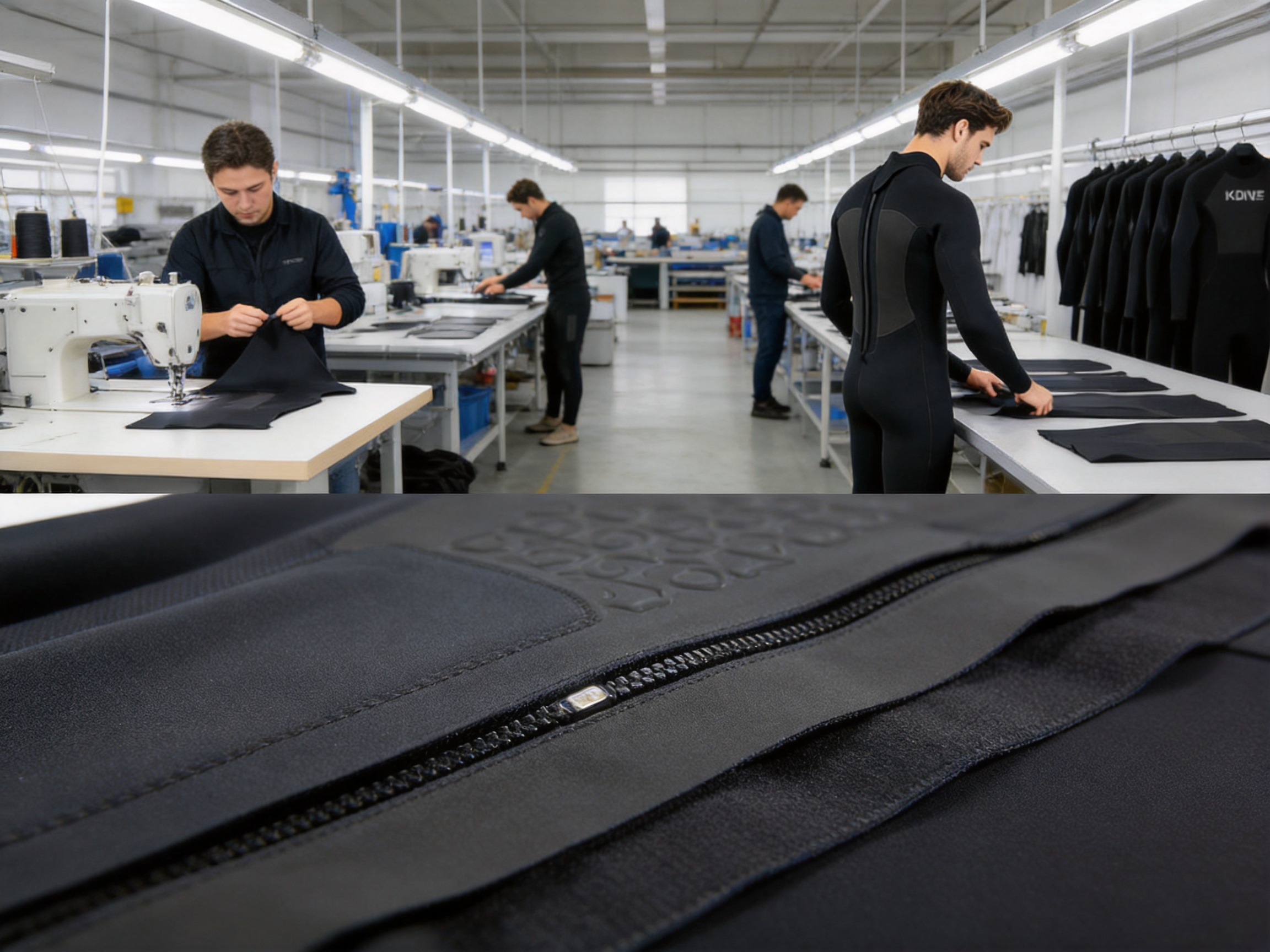
Product performance depends on more than the visible design. It also depends on how materials are selected, stored, cut, laminated, stitched, bonded, inspected, and packed. Jiangsu Yiheng Sports Products Co., Ltd. has developed its business around neoprene materials and finished goods, giving it experience across several stages of the supply chain.
The company began its business journey in 2008 and has accumulated more than 18 years of industry experience in neoprene fabrics and related finished products. Its factory covers more than 15,000 square meters and includes more than 120 professional employees. This scale provides a foundation for organizing material preparation, production scheduling, quality inspection, sample development, and order fulfillment.
Material Selection and Neoprene Expertise
Neoprene is a specialized material that requires attention to thickness, density, flexibility, lamination, surface finish, recovery, and resistance to repeated use. A manufacturer with direct experience in neoprene materials can evaluate how the fabric behaves during cutting and assembly rather than treating it as an ordinary textile.
The nylon-neoprene-nylon structure used for this wetsuit requires consistent bonding between layers. Poor lamination can lead to bubbling, separation, uneven stretch, or premature surface damage. Material inspection and process control are therefore important before the panels reach the sewing and assembly stage.
Pattern Development and Panel Cutting
A wetsuit’s fit and comfort depend on panel geometry. The pattern must account for body movement, stretch direction, seam placement, shoulder rotation, knee flexion, and the need for a close but wearable fit. Accurate cutting helps ensure that matching panels remain consistent across production batches.
For private-label buyers, pattern development can be used to refine the product for a specific market. Adjustments may include size grading, torso proportions, sleeve length, leg length, collar shape, knee reinforcement placement, or branding locations. Sample approval before bulk production helps confirm that the final design meets the buyer’s expectations.
Lamination and Surface Finishing
Lamination joins the nylon surfaces to the neoprene core. Consistent pressure, temperature, adhesive application, and curing conditions help maintain a stable material structure. Surface finishing, including the fine embossed chest panel, must also be controlled to achieve a consistent appearance and functional result.
Embossing requires attention to pattern clarity, pressure, alignment, and the interaction between the embossed surface and the neoprene. The finished panel should remain flexible while providing the intended texture and visual quality.
Sewing, Bonding, and Seam Inspection
The GBS and blind-stitching process requires careful coordination between adhesive bonding and sewing. Operators must manage panel alignment, seam allowance, stitch tension, and edge finishing. Excessive tension may distort the neoprene, while insufficient bonding may reduce seam integrity.
Inspection should look for uneven stitching, skipped stitches, adhesive gaps, loose threads, misaligned panels, open seam sections, and surface marks. Particular attention is appropriate around the shoulders, crotch, knees, zipper area, collar, and other zones exposed to repeated movement.
Component Integration
The zipper, hook-and-loop closure, embossed panel, knee pads, labels, and other components must be integrated without compromising the flexibility of the suit. The YKK back zipper should operate smoothly, and its surrounding construction should be inspected for secure attachment. The collar closure should align correctly and maintain a practical adjustment range.
Knee reinforcement must be positioned consistently from one garment to another. Uneven placement can affect both appearance and function. Consistent component integration is particularly important for private-label customers whose products must present a uniform appearance across a collection.
Quality Control and Testing
Quality control can include incoming material inspection, in-process checks, finished-garment inspection, measurement verification, zipper testing, seam examination, and performance testing. The stated abrasion, hydrostatic, and tensile specifications provide measurable reference points for evaluating the product.
Manufacturers and buyers can also agree on additional inspection criteria, such as acceptable measurement tolerances, color consistency, logo placement, packaging requirements, carton markings, workmanship standards, and sampling procedures. Clear specifications reduce uncertainty and help create repeatable production outcomes.
OEM and ODM Opportunities
The manufacturer’s experience in source manufacturing and direct retail-market practice supports both OEM and ODM cooperation. OEM production is suitable for brands that already have designs, specifications, logos, and packaging requirements. ODM cooperation is useful for buyers who want assistance developing a product based on a market concept or performance objective.
Potential customization areas include color selection, logo application, woven labels, heat-transfer graphics, packaging, hangtags, size grading, collar details, panel design, reinforcement placement, and coordinated accessories. Buyers may also request a product line built around different thicknesses or related water-sports garments.
Private-label customers should define their target consumer before finalizing the product. A recreational SUP brand may prioritize comfort, appearance, and accessible pricing. A rental operator may give greater importance to abrasion resistance, easy dressing, size range, and simple care. A technical water-sports retailer may require detailed material documentation, construction information, and performance testing.
Sampling is an essential stage in the development process. A sample allows the buyer to review the fit, hand feel, flexibility, zipper operation, collar adjustment, reinforcement placement, chest embossing, seam quality, and visual appearance. Feedback should be collected before bulk production so that changes can be incorporated efficiently.
Applications Beyond Stand-Up Paddleboarding
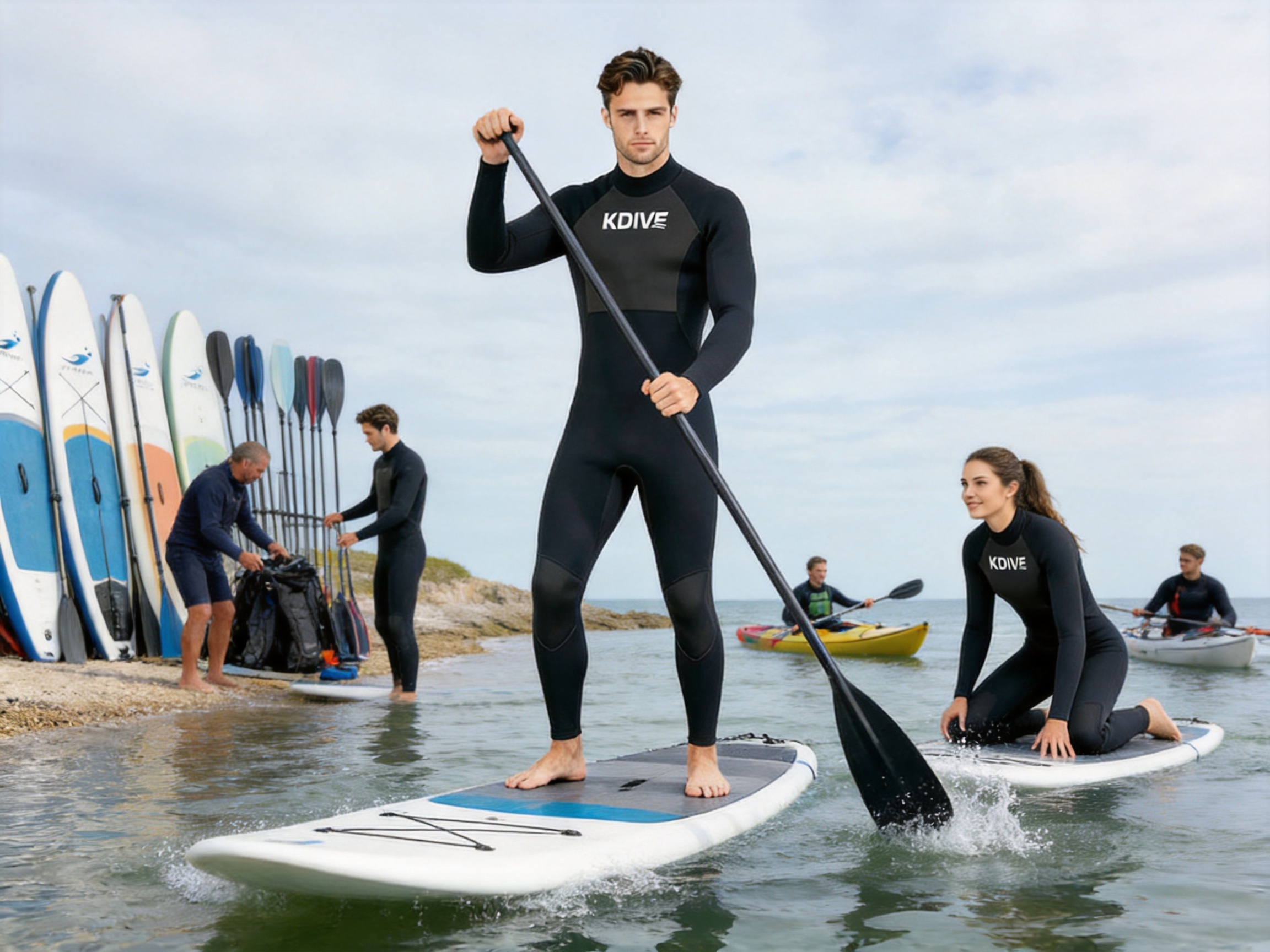
Although the product is designed for SUP use, its construction makes it suitable for several additional water activities. The full-length structure and 3mm neoprene can support recreational kayaking, canoeing, surfing, sailing training, open-water fitness, beach activities, and general cold-water recreation.
Kayakers may appreciate the suit’s flexible upper body and reinforced knees, particularly when entering or exiting a kayak or adjusting position. Canoeists can benefit from full-leg protection and a secure collar during splash-heavy trips. Beginner surfers may value the warmth and coverage provided during repeated falls and board contact.
The suit may also be useful for outdoor education programs, water-sports camps, guided tours, and rental fleets. For these applications, buyers should consider additional factors such as cleaning procedures, drying time, storage space, user turnover, size distribution, and repair support.
The product is not a substitute for a personal flotation device, thermal protection system selected for extreme conditions, or specialized protective equipment required by a particular activity. Users should select equipment according to local water conditions, weather, experience level, and safety guidance.
Fit, Sizing, and User Comfort
A wetsuit performs best when it fits closely without causing painful pressure or limiting breathing and movement. A loose suit may permit excessive water circulation, while a suit that is too tight may cause discomfort and accelerate stress on seams and closures.
The available sizes are S, M, L, XL, XXL, and XXXL. Buyers should use the manufacturer’s measurement chart and compare body measurements rather than choosing solely by standard clothing size. Important measurements may include height, chest, waist, hip, inseam, and torso length.
When trying on the suit, the wearer should check that the shoulders can rotate naturally, the knees can bend, the collar sits securely, and the zipper closes without excessive force. Small wrinkles are normal, but large folds or open gaps may indicate an unsuitable size. The suit should feel close to the body while still allowing normal breathing and paddling motion.
Users should avoid pulling aggressively on thin sections or using fingernails to stretch the neoprene. Dressing slowly and using the palms of the hands can help reduce stress on the material. Sharp jewelry, rough fingernails, and contact with abrasive surfaces should be avoided during dressing.
Care and Maintenance
Proper care can extend the useful life of a wetsuit. After each use, rinse the garment with fresh, clean water to remove salt, sand, mud, chlorine, and other contaminants. Pay attention to the zipper, collar, knee pads, and seam areas.
The suit should be dried in a shaded, well-ventilated location. Direct, intense sunlight and excessive heat may accelerate degradation of neoprene, nylon surfaces, adhesives, and printed components. The garment should not be stored while wet, tightly compressed, or folded repeatedly in the same place.
When possible, hang or store the suit in a way that avoids creating sharp permanent creases. The zipper should be handled carefully, and the hook-and-loop closure should be secured away from exposed neoprene surfaces during storage to reduce the risk of snagging.
Regular inspection can identify small problems before they become larger. Users should check for loose threads, separating seams, damaged zipper teeth, worn knee pads, cuts, and changes in elasticity. Repairs should be completed with materials and methods suitable for neoprene garments.
Commercial Value for Distributors and Retailers
The product offers several features that can support a clear retail message: 3mm thermal insulation, full-length coverage, GBS and blind-stitched seams, an embossed chest panel, reinforced knees, a YKK back zipper, and an adjustable collar. These features are easy to communicate to customers who are comparing wetsuits for paddleboarding or general water recreation.
The black color provides broad market appeal and can coordinate with paddleboards, paddles, flotation devices, gloves, boots, and other accessories. The size range from S to XXXL helps retailers reduce the risk of excluding customers with different body types.
For distributors, the manufacturer’s broader product range may support category expansion. In addition to wetsuits, the company produces drysuits, fishing waders, rash guards, water-sports equipment, and neoprene fabrics. A buyer may therefore develop a more complete water-sports product portfolio through one experienced manufacturing partner.
The company’s direct retail-market experience is also valuable. Understanding how consumers use, compare, and care for water-sports products can improve communication between factory development and market requirements. This experience may help inform product updates, packaging content, size planning, and feature prioritization.
Why Specialized Manufacturing Matters
A wetsuit is a technical garment in which material behavior, fit, seam design, and component integration are closely connected. A supplier may be able to sew a garment, but specialized neoprene manufacturing experience adds knowledge about stretch, lamination, adhesive bonding, surface finishing, and thermal construction.
Jiangsu Yiheng Sports Products Co., Ltd. has developed expertise across both materials and finished products. Its more than 15,000-square-meter facility and workforce of over 120 professional employees provide resources for organized production and quality management. Its history since 2008 demonstrates long-term participation in the industry rather than short-term product trading.
The company’s stated focus is to provide reliable OEM manufacturing, market-oriented ODM development, and long-term supply support. For buyers, this can be important when a product must be repeated over multiple seasons. Consistency in material, dimensions, color, seam construction, and packaging is often as important as the initial sample.
Long-term manufacturing cooperation also creates an opportunity for continuous improvement. Feedback from distributors, retailers, athletes, instructors, and end users can be used to refine patterns, adjust features, improve packaging, or develop related products. A factory with experience in both source materials and finished goods is well positioned to evaluate these changes.
Frequently Asked Questions
What thickness is the Men’s Full-Length SUP Wetsuit?
The wetsuit uses 3mm neoprene laminated with nylon on the inner and outer surfaces. This thickness is designed to balance warmth, flexibility, and movement for paddleboarding and other recreational water activities.
Is the wetsuit suitable only for stand-up paddleboarding?
No. It is designed for SUP but may also be used for kayaking, canoeing, surfing, sailing training, open-water fitness, and general water recreation. Users should select clothing according to the water temperature, weather, activity intensity, and personal comfort requirements.
What does GBS seam construction mean?
GBS generally refers to glued and blind-stitched construction. Adhesive bonding helps close the seam, while blind stitching supports structural strength with reduced penetration compared with conventional exposed stitching. The construction is intended to help minimize water entry through seam lines.
Does the wetsuit provide complete waterproof protection?
No garment should be considered completely waterproof in every situation. The wetsuit is designed to reduce water penetration through its seams and construction. Actual performance depends on fit, movement, water pressure, wear, condition, and the circumstances of use.
Why does the wetsuit have reinforced knee pads?
Knee pads provide additional protection and abrasion resistance in an area that frequently contacts paddleboards and other surfaces. They are particularly useful for users who kneel often, including beginners, instructors, and participants in training or rental programs.
What is the function of the embossed chest panel?
The fine embossed chest panel increases surface friction and helps reduce wind chill across the front of the torso. It also gives the wetsuit a more technical appearance and supports its intended use in wind-exposed paddleboarding conditions.
How does the back-entry zipper help the wearer?
The back-entry YKK zipper supports easier dressing and removal. Its extended pull tab can make the zipper more accessible, while the adjustable hook-and-loop collar helps create a secure fit around the neck.
What sizes are available?
The available sizes are S, M, L, XL, XXL, and XXXL. Buyers should consult the manufacturer’s size chart and compare actual body measurements before selecting a size.
Can the wetsuit be customized for a private-label brand?
The manufacturer provides OEM and ODM services. Potential customization may include branding, colors, labels, packaging, size grading, graphics, panel details, and other product specifications, subject to development discussion and order requirements.
What quality tests are associated with the product?
The provided specifications include no damage after 4,000 abrasion cycles under pressure of at least 9 kPa, hydrostatic resistance of at least 80 kPa with no water seepage under test conditions, and no breakage after 10 seconds under at least 150 N of lengthwise and crosswise tension.
How should the wetsuit be cleaned?
Rinse the suit with fresh water after use, allow it to dry in a shaded and ventilated area, and avoid excessive heat or direct intense sunlight. Store it dry and protect the neoprene from sharp objects, rough surfaces, and unnecessary compression.
What kind of company manufactures the product?
The product is manufactured by Jiangsu Yiheng Sports Products Co., Ltd., a specialist in neoprene materials and finished water-sports products. The company has more than 18 years of industry experience, a factory covering more than 15,000 square meters, and more than 120 professional employees.
Conclusion
The Men’s Full-Length SUP Wetsuit is built around the practical requirements of paddleboarding: thermal comfort, flexibility, full-body coverage, reliable seam construction, resistance to high-wear areas, and convenient dressing. Its 3mm nylon-neoprene-nylon structure provides a balanced foundation, while the embossed chest panel, GBS and blind-stitched seams, reinforced knee pads, YKK back zipper, and adjustable collar add targeted performance benefits.
Compared with basic wetsuits that rely on simple stitching, limited coverage, or unreinforced panels, this product offers a more complete and application-focused construction. Its design is suitable for individual users, water-sports retailers, rental operators, training programs, distributors, and brands developing private-label collections.
The product is further supported by the manufacturing strengths of Jiangsu Yiheng Sports Products Co., Ltd. With experience in both neoprene fabric and finished-product production, more than 18 years in the industry, a factory exceeding 15,000 square meters, and a workforce of over 120 professionals, the company can support material sourcing, product development, production control, OEM programs, ODM projects, and long-term supply cooperation.
For buyers seeking a dependable men’s wetsuit for SUP and related water activities, the combination of 3mm neoprene, full-length coverage, technical seam construction, knee reinforcement, and private-label manufacturing support makes this product a versatile and commercially valuable choice.
References
1. Product specification sheet for the Men’s Full-Length SUP Wetsuit, including materials, thickness, seam construction, closure system, performance requirements, and size range.
2. Manufacturer-provided company information for Jiangsu Yiheng Sports Products Co., Ltd., including factory scale, workforce, product categories, and industry experience.
3. General technical references on neoprene wetsuit construction, laminated textile structures, thermal insulation, and water-sports garment design.
4. General quality-control references concerning abrasion resistance, tensile strength, hydrostatic resistance, seam inspection, and finished-garment testing.
5. General equipment-care references for neoprene garments, including rinsing, drying, storage, zipper handling, and surface protection.
Product: Men's Full Length SUP Wetsuit

LET’S DEVELOP YOUR NEXT NEOPRENE PRODUCT LINE
Quick Links
Product Categories
Contact Us
-
 Email: postmaster@yihengsport.com
-
 Mobile: +86-13564100539
-
 No. 480 Jiangping Road, Madian, Binjiang Town, Taixing City, Taizhou City, Jiangsu Province, China.
Copyright © Jiangsu Yiheng Sports Products Co., Ltd. All Rights Reserved
China Wetsuit Manufacturer Neoprene Fabric Manufacturer
