

 Language
 English
 中文简体
 日本語
 русский
 Español
 عربى

Oct, 12, 2026
5mm Yellow Camouflage Two-Piece Spearfishing Wetsuit: Performance, Protection, and Manufacturing Excellence
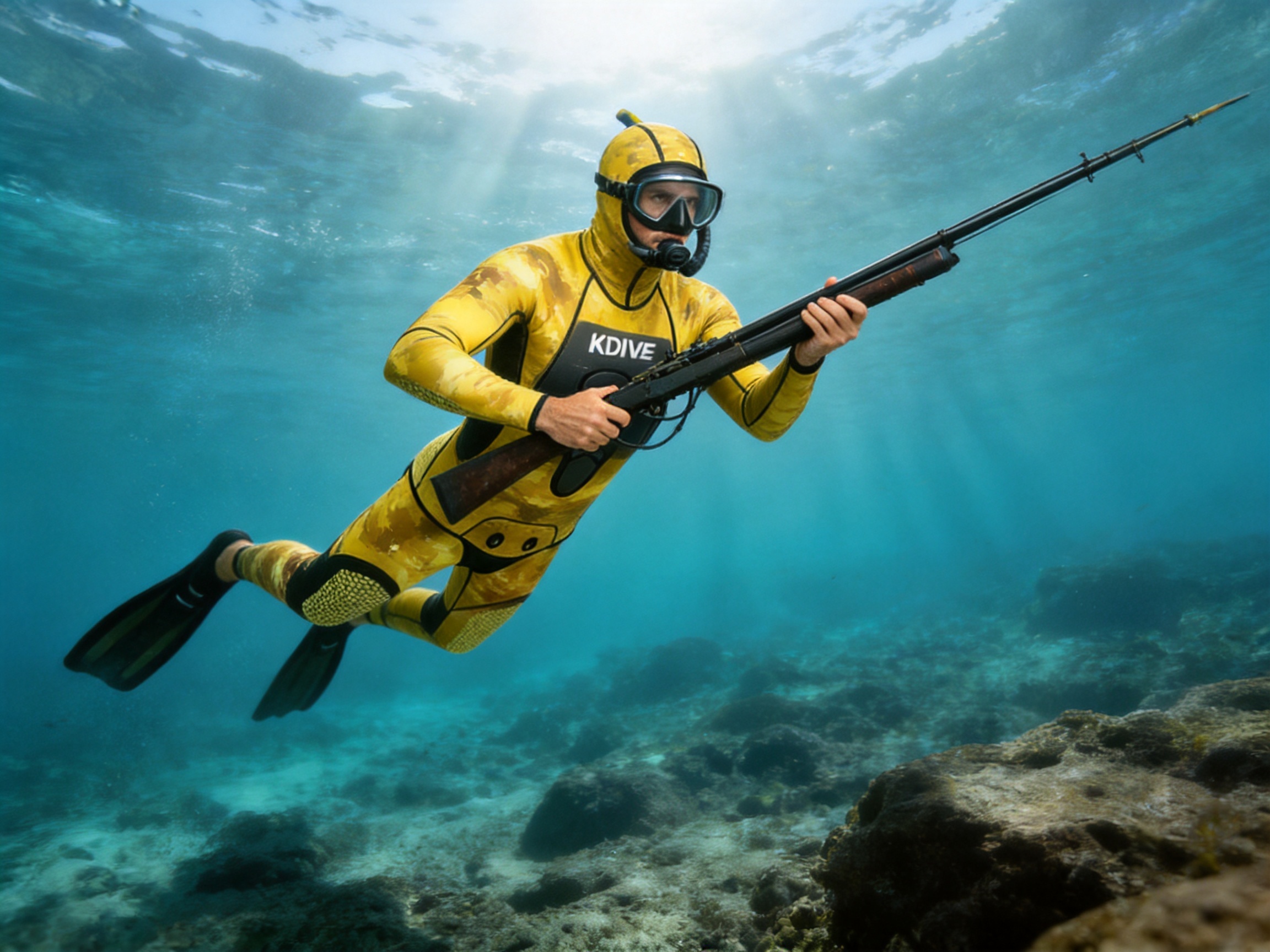
Spearfishing demands equipment that performs reliably across several different conditions at once. A wetsuit must retain body heat, support unrestricted movement, resist abrasion, provide a stable platform for loading a speargun, and remain comfortable during long periods in the water. It must also fit securely enough to limit water flushing without restricting breathing, swimming, or diving technique. The 5mm Yellow Camouflage Two-Piece Spearfishing Wetsuit is designed around these practical requirements.
Combining a split two-piece construction, stretch neoprene, glued and blind-stitched seams, reinforced high-wear zones, silicone grip printing, and a chest loading pad, this wetsuit is developed specifically for spearfishing rather than adapted from a general recreational diving suit. Its camouflage appearance adds a concealment-oriented visual design, while the thermal thickness provides insulation for cooler water and extended sessions.
The product is manufactured by Jiangsu Yiheng Sports Products Co., Ltd., a specialist producer of neoprene fabrics and finished water sports products. Since beginning operations in 2008, the company has developed capabilities across raw-material handling, neoprene product manufacturing, OEM production, ODM development, and market-oriented product refinement. Its factory covers more than 15,000 square meters and employs over 120 professional workers.
This article examines the wetsuit’s construction, performance benefits, competitive advantages, manufacturing strengths, customization potential, maintenance requirements, and suitability for distributors, private-label brands, diving operators, and individual spearfishers.
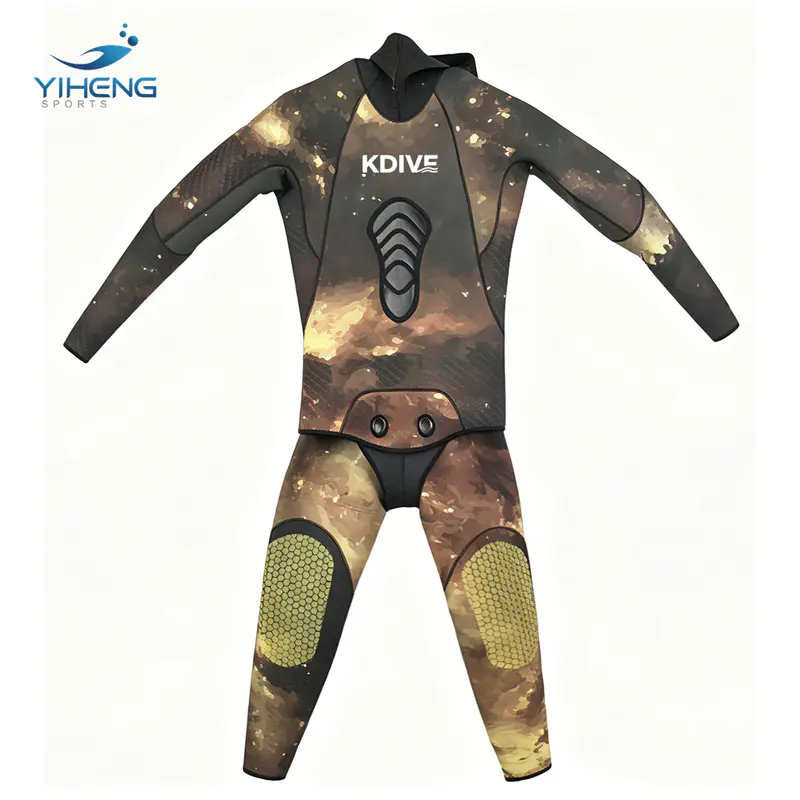
5mm Yellow Camouflage Two-Piece Spearfishing Wetsuit
1. Product Overview
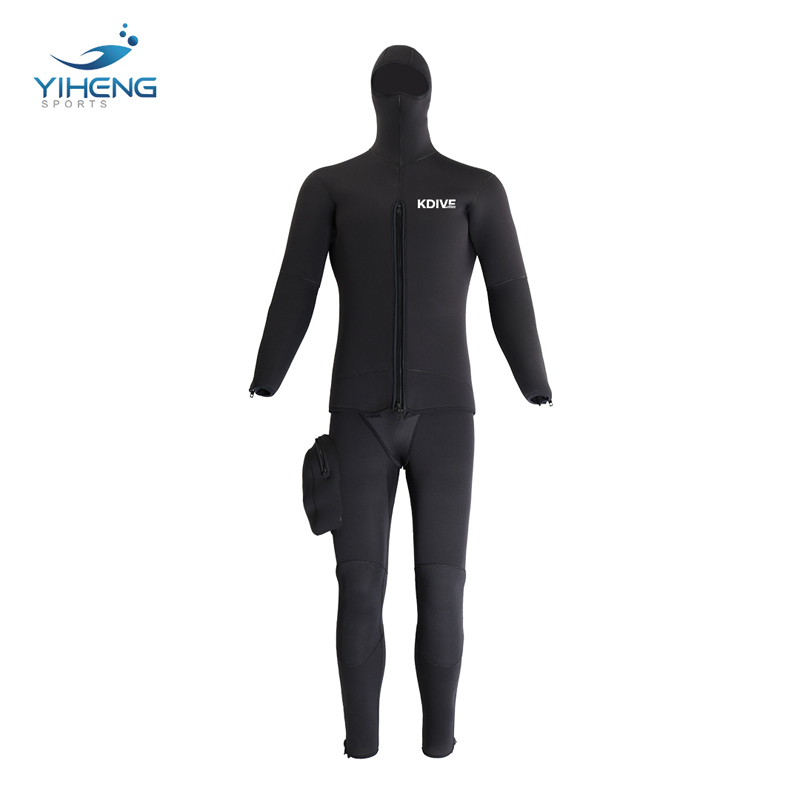
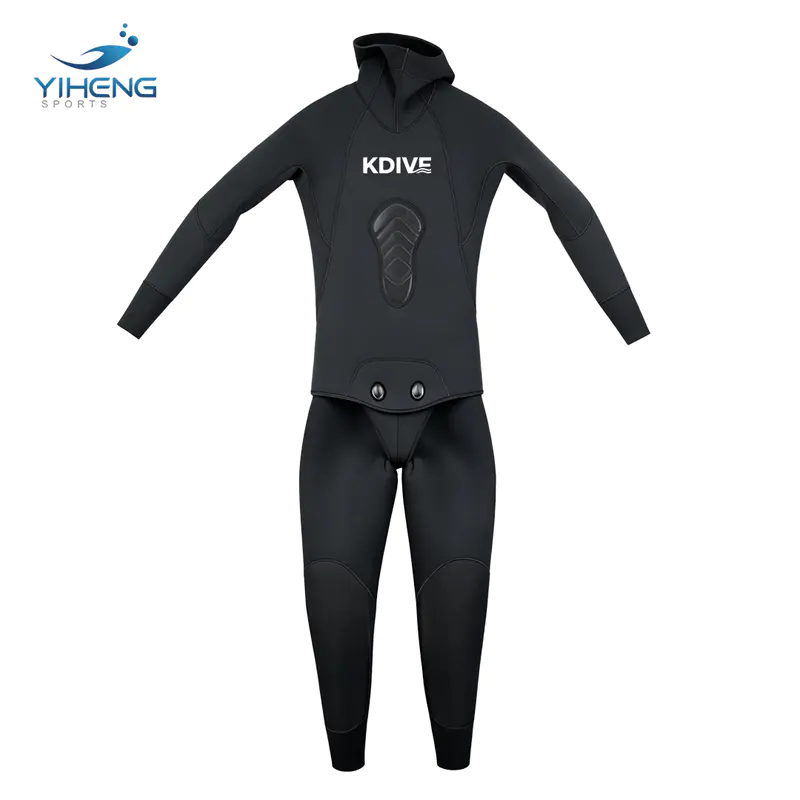
The 5mm Yellow Camouflage Two-Piece Spearfishing Wetsuit is a specialized cold- and moderate-water diving garment consisting of a separate jacket and lower section. The split design is intended to make dressing easier than putting on a full one-piece suit, especially when the suit is made from relatively thick neoprene. It also allows the upper and lower portions to conform more naturally to different areas of the body.
The wetsuit is listed in sizes S, M, L, XL, XXL, and XXXL. This size range enables suppliers to serve a broad portion of the adult spearfishing market. Because fit has a direct effect on thermal performance and comfort, users should select a size according to body measurements and the supplier’s final size chart rather than relying only on ordinary clothing size.
The product specification identifies a super-stretch fabric combined with CR neoprene. The product title describes the garment as a 5mm wetsuit, while the supplied material description also refers to 4mm CR neoprene. This indicates that the final construction may be defined by a 5mm product category or laminated system incorporating a 4mm CR layer. Buyers should confirm the exact finished thickness, laminate structure, and tolerance with the manufacturer before placing a production order.
The outer appearance uses a yellow camouflage pattern. In practical use, camouflage can help reduce visual contrast with the surrounding underwater environment. Its effectiveness naturally depends on water clarity, depth, lighting, background conditions, and the movement of the diver. In addition to its functional purpose, the color pattern gives the product a distinctive identity in a crowded wetsuit market.
Core Product Specifications
| Item | Specification | Functional Purpose |
|---|---|---|
| Product type | Spearfishing wetsuit | Designed for underwater hunting and breath-hold diving |
| Construction | Split two-piece design | Supports easier dressing and a closer anatomical fit |
| Thermal category | 5mm class, with CR neoprene specification to be confirmed | Provides insulation for cooler water and longer sessions |
| Material | Super-stretch fabric and CR neoprene | Balances flexibility, insulation, and comfort |
| Seams | GBS, or glued and blind stitched | Helps reduce water penetration and improve seam durability |
| Protection areas | Knees, seat, elbows, and chest | Addresses abrasion, grip, and speargun-loading pressure |
| Closure | Beavertail with dual snap fasteners | Helps secure the jacket and limit movement during diving |
| Sizes | S, M, L, XL, XXL, XXXL | Supports broad retail and wholesale size coverage |
| Color | Yellow camouflage | Creates a distinctive appearance and concealment-oriented pattern |
2. Why a Two-Piece Spearfishing Wetsuit Is Different
A conventional one-piece wetsuit is convenient for many water sports, but spearfishing often benefits from a dedicated two-piece design. Spearfishers repeatedly transition between walking on shore, entering from a boat, swimming on the surface, diving vertically, kneeling on the seabed, and handling equipment. A suit designed for this activity must accommodate frequent changes in body position.
The split construction separates the jacket from the lower section, making it easier to put on and remove thick neoprene. This is particularly helpful when the diver is preparing beside a boat, at a rocky shore, or in a location where changing space is limited. A two-piece arrangement can also reduce the need to pull the entire garment over the shoulders and hips in one movement.
The jacket and lower section can overlap at the waist, creating an additional barrier against water entry when properly fitted. The beavertail closure helps hold the upper section in position. Dual snap fasteners provide a straightforward closure system that is familiar to many spearfishers and can be operated without complex hardware.
Another advantage is the ability to develop different anatomical shaping for the upper and lower body. The jacket can be designed to support breathing movement, shoulder rotation, and chest protection, while the trousers can be shaped for finning, kneeling, and leg extension. This division is especially valuable in products using thicker neoprene, where poorly positioned seams or excess material can become noticeable during repeated dives.
Improved Preparation and Donning
Thick wetsuits can be difficult to put on because neoprene compresses and grips the skin. The split two-piece design reduces the effort required during dressing. Users can position the lower section first, then put on the jacket separately. This process may be more manageable for divers wearing accessories such as weight belts, dive watches, or protective socks.
Easy donning also has commercial value. A product that is less frustrating to use is more likely to generate positive customer feedback and repeat sales. For retailers, clear product benefits such as convenient dressing can be communicated easily through packaging, product pages, and demonstrations.
3. Thermal Insulation and Stretch Performance
The wetsuit uses neoprene as its main thermal material. Neoprene helps slow heat loss by creating an insulating layer around the body. A 5mm-class suit is commonly selected for cooler water, extended breath-hold sessions, or divers who require more protection than a thin tropical-water suit can provide.
Thermal performance depends on more than nominal thickness. Fit, seam construction, lining materials, water circulation, compression at depth, and the diver’s activity level all affect warmth. A properly fitted suit reduces the movement of cold water inside the garment and allows the neoprene to maintain its insulating function.
The super-stretch fabric is important because thick neoprene can otherwise feel rigid. Stretch material allows the diver to rotate the shoulders, bend the hips, kick efficiently, and maintain a streamlined position during descent. It also makes the garment easier to fit across different body shapes, although stretch should not be treated as a substitute for correct sizing.
CR neoprene is widely used in performance water sports products because it offers a useful balance of flexibility, resilience, and thermal insulation. When laminated with an appropriate stretch fabric, it can provide a soft and adaptable inner feel while retaining structural strength. The exact performance depends on the grade of neoprene, fabric weight, lamination method, cell structure, and quality controls used by the manufacturer.
For buyers comparing this product with entry-level wetsuits, the combination of stretch fabric and a spearfishing-specific thickness can be a meaningful advantage. Some lower-cost suits prioritize price by using less flexible materials or simplified seams. Those products may be acceptable for occasional recreational use but can become uncomfortable during repeated dives or when the diver must load a speargun, move over rocks, and maintain a controlled body position.
Thermal Comfort During Extended Sessions
Spearfishing sessions often involve alternating periods of surface swimming, breath-hold diving, waiting, and equipment handling. The diver may not maintain a constant high level of physical activity. Reliable insulation is therefore important, especially when the water is cool or when the session lasts several hours.
The suit’s thickness and close fit help limit heat loss while the stretch construction reduces the restrictive feeling associated with some thick wetsuits. The result is a balance between warmth and mobility. Divers should nevertheless select thickness according to local water temperature, personal cold tolerance, diving duration, and safety planning.
Because the supplied specifications mention both a 5mm product designation and 4mm CR neoprene, wholesale buyers should request a technical datasheet or sample measurement. Confirming the actual finished thickness is important when the suit is intended for markets with specific thermal expectations or labeling requirements.
4. Spearfishing-Specific Protection
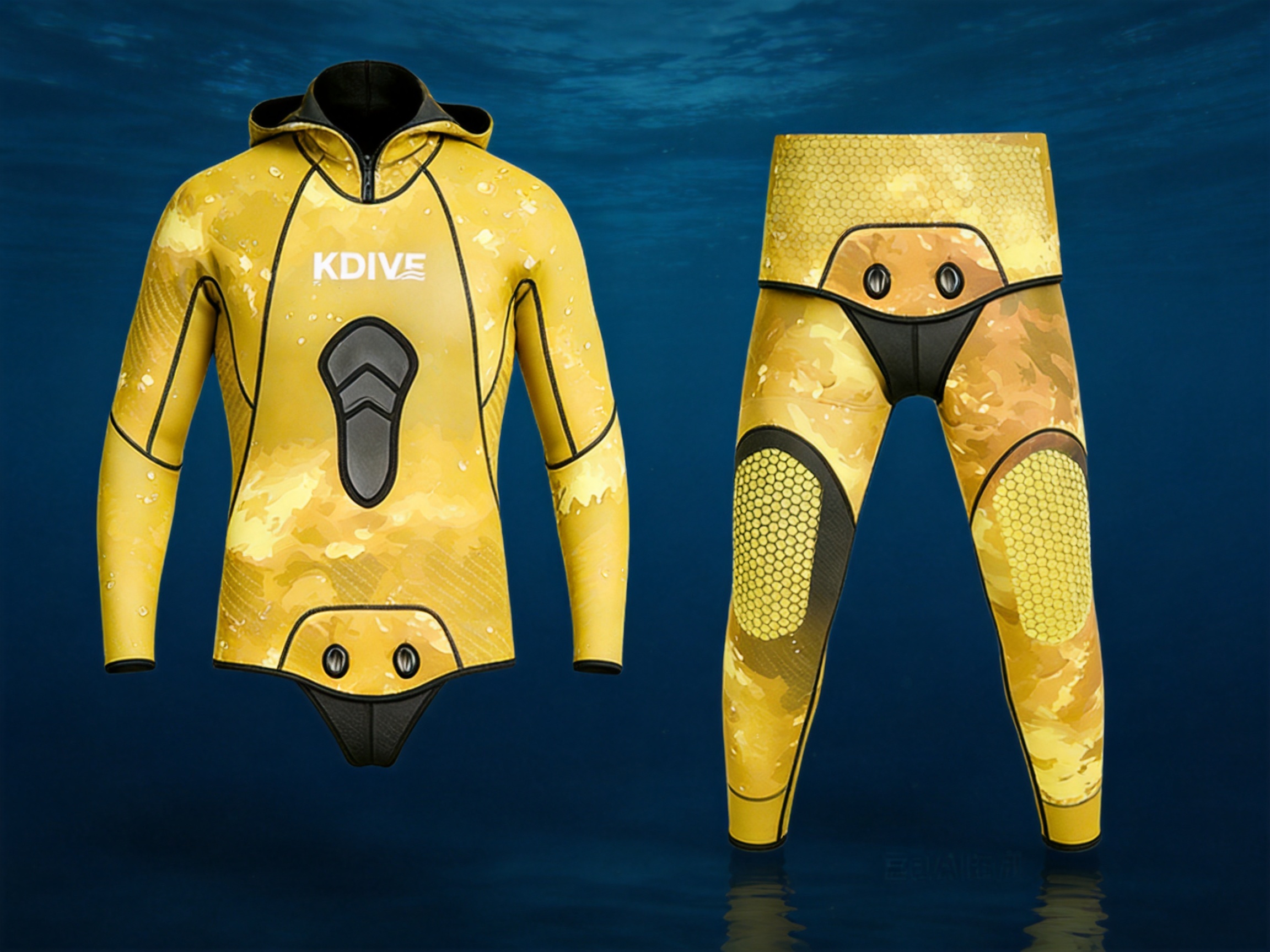
The most important difference between a dedicated spearfishing wetsuit and a general swimming or surfing wetsuit is the placement of protective features. Spearfishers interact with spearguns, rocks, boat surfaces, seabeds, fins, weight belts, and other equipment. The suit must therefore protect common contact points without creating excessive bulk.
Chest Loading Pad
The chest area includes a thickened anti-slip silicone pad intended to support speargun loading. When a speargun band is drawn back, the diver often braces the handle or stock against the chest. Without suitable reinforcement, repeated loading can cause discomfort, pressure points, or accelerated wear to the wetsuit.
The chest pad distributes pressure across a more stable area and gives the speargun a less slippery contact surface. This can make loading more controlled and reduce movement between the equipment and the suit. The pad is not a replacement for correct loading technique or safe handling, but it is a practical feature for the intended activity.
Compared with a standard diving wetsuit, the inclusion of a dedicated chest reinforcement gives this product a clear use-case advantage. A generic suit may provide insulation but lack the surface structure needed for repeated speargun loading. For retailers, this feature offers an easy way to distinguish the product from ordinary watersports garments.
Knee and Elbow Reinforcement
Spearfishers may kneel on the seabed, brace against rocks, crawl into position, or use their arms to stabilize themselves around a boat or shoreline. The knees and elbows are consequently exposed to repeated abrasion. Silicone anti-slip printing in these areas improves grip and adds a protective layer at high-contact points.
The silicone pattern can help prevent the fabric from sliding against smooth surfaces. It may also reduce direct friction between the suit and rough equipment. While no wetsuit should be treated as puncture-proof, strategically placed printing can extend service life in demanding conditions when combined with careful handling.
Seat Grip and Abrasion Resistance
The seat area is exposed to pressure and friction when a diver sits on a boat bench, rests on a rocky surface, or adjusts position while wearing equipment. Silicone printing helps improve contact stability and supports durability in this high-wear zone.
These reinforced areas demonstrate that the suit has been designed around real spearfishing movements rather than only around appearance. The protection is targeted where it is most useful, allowing the remainder of the suit to stay flexible and relatively lightweight.
5. GBS Seam Construction
Seams are among the most important structural elements in a wetsuit. Even high-quality neoprene cannot provide reliable performance if seams allow excessive water entry or separate under repeated stretching. This model uses GBS construction, meaning glued and blind stitched seams.
In a glued and blind-stitched seam, the neoprene panels are bonded and then stitched in a way that limits needle penetration through the entire material thickness. The adhesive helps close the seam, while the stitching reinforces the joint. This construction is commonly used in performance wetsuits because it can improve water resistance, durability, and comfort compared with basic flatlock stitching.
Reduced seam penetration can also help limit cold-water pathways. No wetsuit seam can eliminate all water movement under every condition, but careful GBS construction can reduce flushing and preserve more of the garment’s thermal efficiency.
Manufacturing Importance of Seam Quality
GBS performance depends on process control. The adhesive must be applied consistently, the surfaces must be clean, the panels must be accurately aligned, and the stitching must follow the intended seam allowance. Inadequate curing, uneven pressure, contamination, or excessive needle penetration can compromise the finished garment.
A manufacturer with experience in both neoprene materials and finished products is better positioned to manage these variables. Production knowledge begins with material selection and continues through cutting, lamination, panel assembly, bonding, stitching, printing, inspection, and packing. Integrated experience can help reduce inconsistencies between material behavior and garment construction.
For private-label buyers, seam quality should be evaluated through pre-production samples, visual inspection, stretch testing, and practical wear trials. It is also advisable to define acceptable standards for adhesive overflow, open seams, loose threads, misalignment, print defects, and snap fastening strength.
6. Competitive Advantages
The product competes in a market that includes low-cost recreational wetsuits, surfing suits, generic diving suits, and premium spearfishing garments. Its strongest position is the combination of activity-specific features and factory customization potential.
Activity-Specific Design
A general-purpose wetsuit may provide basic warmth, but this model adds a chest loading pad, silicone grip zones, camouflage styling, and a beavertail closure. These details directly address common spearfishing requirements. Buyers are not paying only for neoprene thickness; they are purchasing a garment developed around the movements and equipment of underwater hunting.
Balance of Mobility and Insulation
Thicker wetsuits often provide more warmth but can restrict movement. The use of super-stretch fabric helps offset that problem. Divers can move their shoulders and hips more naturally while still benefiting from substantial insulation. This balance can be especially attractive to intermediate and serious users who want more performance than a budget suit but do not necessarily require a highly specialized premium model.
Targeted Reinforcement Instead of Excessive Bulk
The suit reinforces the chest, knees, elbows, and seat rather than adding heavy protective material everywhere. This approach preserves flexibility in less exposed areas and keeps the product focused on the locations most likely to experience pressure or abrasion.
Broad Size Availability
The range from S through XXXL supports multiple body profiles and gives distributors a practical size assortment. Broad sizing can reduce missed sales caused by limited availability. It also helps private-label brands build a complete product offering instead of carrying only a narrow set of common sizes.
Distinctive Visual Identity
Yellow camouflage provides a strong shelf and catalog presence. Many wetsuits use plain black or dark camouflage, so a yellow pattern can help a product stand out in online listings and retail displays. It can also support a specific brand identity for distributors seeking a recognizable spearfishing collection.
Factory-Level Customization Potential
Because the manufacturer specializes in OEM and ODM production, buyers can discuss custom labels, packaging, colors, patterns, logos, material combinations, and product adjustments. The feasibility of each change depends on order quantity, tooling, artwork, material availability, and production planning, but direct factory communication can simplify the development process.
7. Manufacturing Capabilities
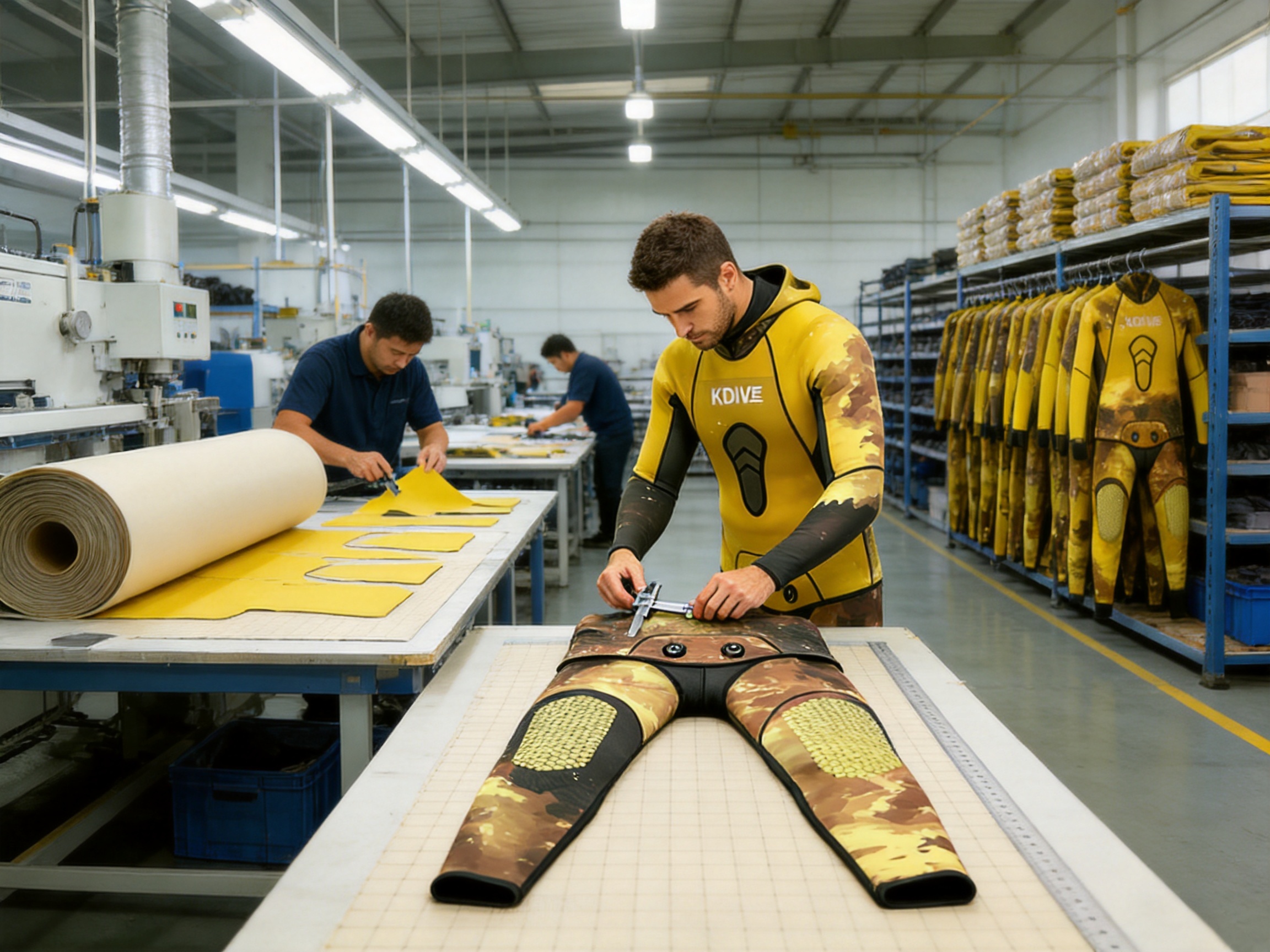
Jiangsu Yiheng Sports Products Co., Ltd. began its entrepreneurial journey in 2008. From its early work with raw materials and semi-finished products, the company has expanded into the manufacture of neoprene fabrics and finished water sports products. Its stated experience includes more than 15 years of production knowledge, more than 18 years of industry development, and eight years of direct retail-market practice.
This combination of manufacturing and market experience is valuable because product development requires more than the ability to assemble garments. A factory must understand how raw materials behave, how construction affects comfort, what customers expect at retail, and which features are practical at different price levels.
The factory covers more than 15,000 square meters and employs over 120 professional workers. A production base of this scale can support organized material storage, cutting operations, sewing and seam assembly, inspection, product development, and order coordination. The exact machinery, certifications, and quality systems should be confirmed for each project, but the stated facility size indicates a substantial production platform rather than a small trading operation.
Material-to-Product Integration
Yiheng’s product range includes neoprene fabrics, wetsuits, drysuits, fishing waders, rash guards, and water sports equipment. This breadth creates an opportunity for cross-category material knowledge. For example, experience with neoprene fabric can support the selection of suitable materials for wetsuit panels, while experience with fishing waders and drysuits can contribute to understanding waterproof construction and demanding outdoor use.
Integrated product knowledge also helps when buyers request a coordinated collection. A distributor may need a spearfishing wetsuit, rash guard, gloves, accessories, or seasonal water sports products with compatible colors and branding. Working with a manufacturer experienced across several categories can simplify communication and improve consistency.
OEM and ODM Support
OEM production is appropriate when a buyer already has a defined design and needs the factory to manufacture it under a private label. ODM support is useful when the buyer wants the manufacturer to contribute design ideas, construction recommendations, material selection, or product refinement.
For this wetsuit, OEM and ODM discussions may cover the following points:
• Custom logo placement on the chest, sleeve, thigh, packaging, or hangtag.
• Alternative camouflage patterns or color combinations.
• Private-label labels, size labels, care labels, and packaging.
• Adjustments to pad shape, silicone print layout, snap placement, or panel design.
• Different thicknesses for warm-water, temperate-water, or cold-water markets.
• Custom size charts based on the target region and customer profile.
• Coordinated designs for rash guards, gloves, socks, hoods, or other accessories.
Every customization should be approved through technical drawings, material samples, size specifications, and a pre-production sample. This procedure reduces the risk of differences between the buyer’s expectation and the mass-produced result.
8. Production Process for a High-Performance Wetsuit
A reliable wetsuit is the result of many controlled stages rather than a single manufacturing operation. The following process provides a practical overview of how a product of this type is typically developed and produced.
Material Selection and Inspection
The process begins with neoprene and laminated fabric selection. Materials are evaluated for thickness, stretch, surface appearance, color consistency, softness, resilience, and bonding quality. Rolls should be inspected before cutting so that defects can be identified early.
For a camouflage wetsuit, color matching is particularly important. Different production lots should be checked against an approved standard because variations in yellow tone, contrast, or pattern density can affect the appearance of a complete order.
Pattern Development
Patterns determine the garment’s anatomical shape, seam placement, movement allowance, and material consumption. A spearfishing wetsuit requires special consideration around the shoulders, chest, waist, hips, knees, and elbows. The pattern should provide mobility while maintaining enough compression for thermal performance.
Pattern development may begin with an existing model and then be refined through samples. Wear testing can reveal issues that are difficult to identify from measurements alone, such as tension across the shoulders, excess material behind the knees, or uncomfortable pressure at the beavertail closure.
Precision Cutting
Accurate cutting ensures that panels match the approved pattern and that the stretch direction is positioned correctly. Neoprene often has different behavior along different orientations, so panel direction matters. Incorrect orientation can reduce mobility or create uneven tension.
Camouflage panels must also be managed carefully when visual continuity is important. Pattern placement should be reviewed so that major design elements do not appear unintentionally misaligned across the chest, back, or legs.
Lamination and Printing
Stretch fabric is laminated to the neoprene core using controlled pressure, temperature, and adhesive conditions. The finished laminate should remain flexible and resist separation during repeated bending and stretching.
Silicone grip printing is then applied to designated areas such as the chest, knees, elbows, and seat. Print thickness, adhesion, pattern definition, and placement should be checked. The printing must provide grip without becoming excessively rigid or uncomfortable against the skin.
Panel Assembly and GBS Seaming
Cut panels are aligned and assembled in the required sequence. The glued and blind-stitched seam process requires careful control of bonding surfaces, seam allowances, thread tension, and stitch depth. Skilled operators help ensure that curved sections and high-stretch areas remain smooth and secure.
Seams should be inspected for gaps, puckering, uneven adhesive, loose stitching, and excessive needle penetration. Critical areas such as the shoulders, armholes, crotch, knees, and waist deserve particular attention because they experience repeated movement.
Closure and Reinforcement Installation
The beavertail section and dual snap fasteners are attached after the main body has been assembled. Snap placement must be consistent so the closure lies flat and holds the jacket securely. The chest reinforcement is positioned according to the approved sample and checked for bonding and edge quality.
Final Inspection and Packing
Finished garments are inspected for dimensions, appearance, seam integrity, print quality, snap function, labels, and packaging. A final inspection may also include stretching selected areas to identify weak bonding or open seams.
For private-label orders, packaging inspection should verify barcode information, language requirements, care instructions, carton markings, and quantity. These details are essential for smooth distribution even though they are not visible during underwater use.
9. Performance in Practical Spearfishing Conditions
The wetsuit is intended for a demanding combination of environments. A diver may begin on a rocky shore, pass through a boat deck, enter the water, swim at the surface, descend repeatedly, and kneel or brace against underwater terrain. Each stage places different demands on the garment.
On rocky shores, the knee and seat reinforcement can help reduce wear during movement and preparation. On a boat, the silicone printing can improve grip against smooth or wet surfaces. During diving, the stretch construction supports shoulder and hip movement, while the thermal neoprene helps retain warmth.
During speargun loading, the chest pad gives the diver a more stable contact area. During underwater positioning, the camouflage pattern provides a low-contrast appearance relative to the diver’s surroundings, although divers should select patterns according to local conditions rather than assuming any camouflage will work equally well in all environments.
The beavertail closure supports a secure fit as the diver moves, bends, and rotates. A secure closure may reduce unwanted shifting between the jacket and lower section. Correct fit remains essential; a closure cannot compensate for a suit that is too loose or incorrectly proportioned.
10. Buyer and Distributor Considerations
Wholesale buyers should evaluate the product from both a technical and commercial perspective. Technical verification should include material thickness, neoprene grade, stretch percentage, seam construction, pad material, silicone print adhesion, snap durability, and size measurements.
Commercial evaluation should consider target water temperatures, customer experience, preferred colors, packaging requirements, minimum order quantities, lead times, shipping cartons, and replacement policies. A product that performs well but lacks suitable packaging or size labeling may still create difficulties in the retail channel.
Recommended Sample Approval Checklist
1. Confirm the finished neoprene thickness and laminate composition.
2. Compare the sample against the approved color and camouflage artwork.
3. Test shoulder, hip, knee, and elbow mobility.
4. Inspect all GBS seams for continuity and clean bonding.
5. Check that the chest pad is correctly positioned and securely attached.
6. Test the beavertail closure and both snap fasteners.
7. Confirm silicone grip printing on the chest, knees, elbows, and seat.
8. Measure each size against the agreed technical size chart.
9. Review labels, logos, care instructions, and packaging.
10. Conduct practical wear testing in representative conditions where possible.
Buyers should also confirm whether the product is intended for direct consumer sale, rental use, professional instruction, or expedition supply. Rental and training environments may require different reinforcement standards and inspection intervals than private recreational use.
11. Care, Storage, and Service Life
Proper care helps preserve neoprene flexibility, seam integrity, silicone grip, and closure performance. After every use, the wetsuit should be rinsed thoroughly with clean fresh water to remove salt, sand, mud, and chlorine. Particular attention should be given to snaps, seam edges, printed areas, and the inside of the beavertail.
The suit should be dried in a shaded, well-ventilated location. Direct sunlight and excessive heat can accelerate fading, drying, and material aging. Hanging the suit from a narrow hanger while it is wet may stretch the shoulders. A wide hanger or carefully supported drying method is preferable.
Users should avoid pulling forcefully on thin edges or using fingernails to stretch the neoprene into place. A suitable wetsuit lubricant may be used when compatible with the material and manufacturer’s care guidance. Oil-based products, harsh solvents, and unsuitable detergents can damage neoprene, adhesives, or silicone printing.
Before storage, the wetsuit should be completely dry. Long-term folding in sharp creases can leave permanent compression marks. If folded, it should be stored loosely with minimal pressure. Frequent users should inspect the seams and reinforcement areas regularly and repair small issues before they become larger openings.
12. Safety and Fit Considerations
A wetsuit contributes to thermal protection but is not a complete diving safety system. Spearfishers must follow appropriate breath-hold diving practices, use suitable weight and buoyancy procedures, dive with a trained partner where required, and observe local laws and marine regulations.
The wetsuit should fit closely without causing breathing restriction, numbness, excessive pressure, or loss of circulation. A suit that is too loose may allow water flushing and reduce warmth. A suit that is too tight may limit movement and cause discomfort. The chest pad should not interfere with breathing or equipment placement.
Users should also test the suit with their usual mask, snorkel, fins, weight belt, gloves, and speargun. Equipment interaction can reveal practical issues that are not apparent when trying on the wetsuit alone.
13. Frequently Asked Questions
Q1: What type of activity is this wetsuit designed for?
This wetsuit is designed primarily for spearfishing and breath-hold diving. Its chest loading pad, camouflage appearance, silicone grip printing, reinforced high-wear areas, and secure beavertail closure are intended for the movements and equipment associated with spearfishing.
Q2: Is the wetsuit suitable for scuba diving?
It may be used for some scuba applications if the thickness and fit are appropriate for the water temperature, but the design is optimized for spearfishing. Scuba divers should assess buoyancy, equipment compatibility, certification requirements, and local conditions before use.
Q3: Why is the garment made in two pieces?
The split two-piece construction makes dressing easier and supports an anatomical fit. It also allows the jacket and lower section to be shaped for different movements. The overlapping design and beavertail closure help keep the suit in position during activity.
Q4: What does GBS mean?
GBS means glued and blind stitched. The panels are bonded with adhesive and reinforced with stitching that does not fully penetrate the material in the same way as basic through-stitching. This construction helps improve seam durability, comfort, and resistance to water penetration.
Q5: What is the purpose of the chest pad?
The thickened anti-slip chest pad provides a more stable and protected surface when loading a speargun. It helps distribute pressure and reduce sliding between the speargun and the wetsuit.
Q6: What do the silicone prints do?
Silicone printing on the chest, knees, elbows, and seat improves grip and adds protection in high-contact areas. It can help reduce slipping and abrasion, although the suit should still be handled carefully around sharp rocks and equipment.
Q7: What sizes are available?
The listed sizes are S, M, L, XL, XXL, and XXXL. Buyers should use the manufacturer’s final measurement chart because wetsuit sizing depends on height, chest, waist, hip, and body shape.
Q8: Is the yellow camouflage only decorative?
No. The camouflage pattern provides a distinctive appearance and is intended to reduce visual contrast in some underwater environments. Its concealment effect varies according to water clarity, depth, light, and surroundings.
Q9: What is the exact neoprene thickness?
The product is presented as a 5mm wetsuit, while the supplied material information also refers to 4mm CR neoprene. The exact finished construction should be confirmed with the manufacturer through a technical datasheet or approved sample before ordering.
Q10: Can the product be customized?
The manufacturer offers OEM manufacturing and ODM development support. Potential customization may include logos, labels, packaging, colors, camouflage patterns, sizes, reinforcement details, and coordinated accessories. Final options depend on order requirements and technical feasibility.
Q11: How should the wetsuit be cleaned?
Rinse it with fresh water after use, allow it to dry in a shaded ventilated area, and avoid harsh chemicals, excessive heat, and direct sunlight. The suit should be stored dry and without sharp folds.
Q12: What makes this wetsuit different from a standard recreational wetsuit?
It combines thermal neoprene with spearfishing-specific details, including a chest loading pad, camouflage styling, silicone grip printing, reinforced knees, elbows, and seat, a beavertail closure, and GBS seams. These features address the needs of divers who load spearguns and move through demanding shore, boat, and underwater environments.
14. Overall Assessment
The 5mm Yellow Camouflage Two-Piece Spearfishing Wetsuit is a purpose-built product for divers who need warmth, movement, grip, and targeted protection in one garment. Its main strengths are the split construction, stretch neoprene system, GBS seam assembly, chest loading reinforcement, silicone anti-slip printing, and distinctive camouflage design.
Compared with a generic wetsuit, it offers more direct support for spearfishing movements and equipment handling. Compared with an entry-level suit, its construction and reinforcement details are better aligned with repeated use in challenging environments. Compared with highly specialized premium products, it may provide an attractive balance of practical features, broad sizing, factory customization, and scalable supply.
The manufacturing background of Jiangsu Yiheng Sports Products Co., Ltd. adds further value for wholesale and private-label customers. The company’s experience with neoprene fabrics and finished water sports products, its factory scale, and its OEM and ODM capabilities allow buyers to discuss both standard supply and tailored product development.
For the best result, buyers should confirm the finished thickness, material specification, size chart, customization details, quality standards, packaging, and production schedule before placing an order. With suitable fit and proper care, this wetsuit can serve as a dependable component of a spearfishing equipment range for retailers, distributors, and active divers.
References
1. Product specification sheet for the 5mm Yellow Camouflage Two-Piece Spearfishing Wetsuit.
2. Manufacturer-provided information concerning neoprene materials, GBS seam construction, silicone reinforcement, product sizes, and closure design.
3. Jiangsu Yiheng Sports Products Co., Ltd. company profile and manufacturing background.
4. General technical references on neoprene insulation, laminated stretch fabrics, and wetsuit construction.
5. General garment quality-control practices for bonded seams, printed silicone components, closures, and dimensional inspection.
Product: 5mm Yellow Camouflage Two-Piece Spearfishing Wetsuit

LET’S DEVELOP YOUR NEXT NEOPRENE PRODUCT LINE
Quick Links
Product Categories
Contact Us
-
 Email: postmaster@yihengsport.com
-
 Mobile: +86-13564100539
-
 No. 480 Jiangping Road, Madian, Binjiang Town, Taixing City, Taizhou City, Jiangsu Province, China.
Copyright © Jiangsu Yiheng Sports Products Co., Ltd. All Rights Reserved
China Wetsuit Manufacturer Neoprene Fabric Manufacturer
