

 Language
 English
 中文简体
 日本語
 русский
 Español
 عربى

Oct, 30, 2026
Men’s 2mm Neoprene Sleeveless Long John Wetsuit for Sailing and Diving
Choosing the right wetsuit can make a significant difference to comfort, mobility, thermal protection, and durability on the water. For sailors, divers, paddle-sport users, and other water sports enthusiasts, a long john wetsuit must provide more than basic insulation. It must move naturally with the body, resist repeated abrasion, remain comfortable during extended activity, and offer dependable protection in changing nearshore conditions.
The Men’s 2mm Neoprene Sleeveless Black and Grey Long John Wetsuit is designed around these requirements. Combining super-stretch fabric, 2mm CR neoprene, a warm brushed lining, reinforced high-wear zones, adjustable shoulder straps, and four-needle six-thread stitching, this sleeveless one-piece wetsuit offers a practical balance between flexibility, thermal retention, and long-term wear resistance.
Its design is especially suitable for users who need unrestricted movement through the shoulders and arms while still benefiting from coverage across the torso, hips, and legs. Compared with a full-sleeve wetsuit, the sleeveless construction allows easier arm rotation for sailing, paddling, swimming, and equipment handling. Compared with thinner single-layer garments, the three-layer composite structure provides more reliable protection against cool water and wind exposure.
Produced by Jiangsu Yiheng Sports Products Co., Ltd., the wetsuit reflects the manufacturing capabilities of a specialist company with extensive experience in neoprene materials and finished water sports products. The company combines source-material expertise, practical product development, OEM manufacturing, ODM support, and private-label production to serve professional buyers, distributors, retailers, and water sports brands.
Product Overview
This long john wetsuit is a sleeveless, one-piece garment designed for men participating in sailing, diving, kayaking, paddle sports, recreational swimming, and related water activities. Its long-leg silhouette protects the core and lower body while leaving the shoulders and arms open for improved mobility.
The wetsuit uses a 2mm CR neoprene composite material. CR neoprene is commonly selected for water sports apparel because it combines flexibility, buoyancy, insulation, and resilience. In this design, the neoprene is integrated with an outer super-stretch fabric and an inner brushed lining. The result is a lightweight multi-layer construction that provides warmth without creating the heavy or restrictive feeling associated with thicker cold-water suits.
The black and grey color combination gives the garment a practical and modern appearance. Black provides a clean base for active use, while grey splicing adds visual distinction and supports a contemporary private-label product design. A custom logo can be added to the chest, making the wetsuit suitable for branded collections, teamwear, promotional programs, and bulk export orders.
| Product Feature | Specification or Design Benefit |
|---|---|
| Product type | Men’s sleeveless long john wetsuit |
| Primary application | Sailing, diving, and general water sports |
| Neoprene thickness | 2mm CR neoprene |
| Material structure | Super-stretch outer fabric, neoprene core, brushed inner lining |
| Color | Black with grey spliced panels |
| Fastening system | Adjustable shoulder straps with hook-and-loop fasteners |
| Reinforcement areas | Knees and hips |
| Reinforcement material | Ottoman reinforcement fabric |
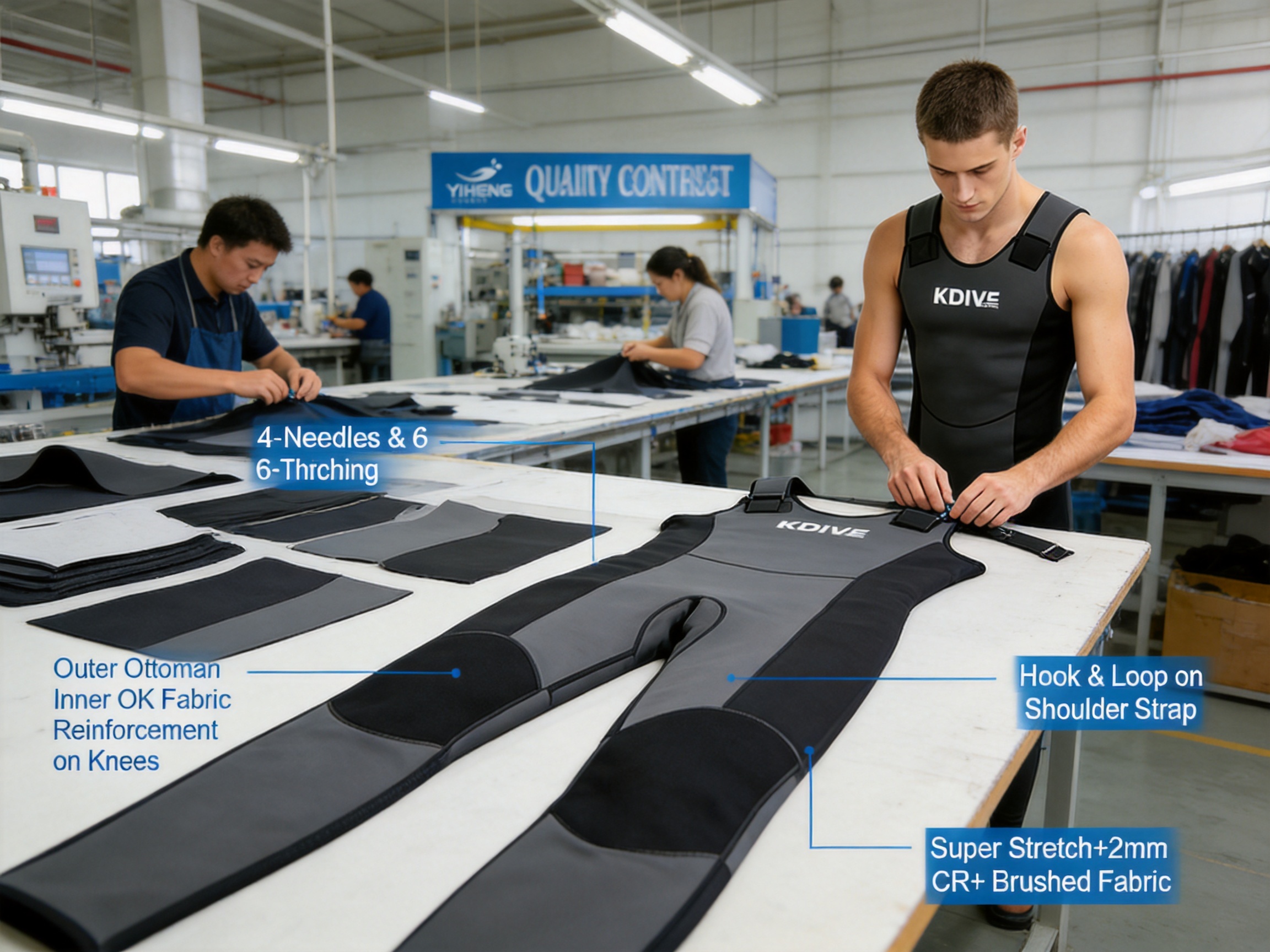
| Stitching process | Four-needle six-thread stitching |
| Branding option | Custom chest logo available |
| Fit concept | Close-fitting 3D athletic cut |
Three-Layer Composite Material
The central advantage of this wetsuit is its balanced three-layer material structure. Each layer performs a different function, and together they create a garment that is flexible, protective, and comfortable during active use.
Super-Stretch Outer Fabric
The outer fabric is designed to support elasticity and help the wetsuit follow body movement. When a sailor reaches for a rope, a diver adjusts equipment, or a paddler rotates the torso, the outer layer must stretch without pulling excessively at the shoulders, waist, or knees.
A flexible outer surface also supports easier dressing and removal. This is important for users who may need to change quickly beside a boat, at a beach, or in a marina. Excessively rigid wetsuit materials can make dressing tiring and may create pressure points. The stretch-focused outer layer helps reduce this problem while supporting a close, performance-oriented fit.
2mm CR Neoprene Core
The 2mm neoprene layer provides the principal thermal and cushioning function. It helps slow the movement of heat away from the body and creates a protective barrier between the user and cool water. At the same time, the moderate thickness keeps the garment lighter and more flexible than a heavier cold-water wetsuit.
For nearshore activities, transitional seasons, indoor or temperate water environments, and high-movement sports, a 2mm construction can be a practical choice. Users often need enough insulation to remain comfortable without sacrificing the ability to paddle, climb, steer, swim, or operate equipment. The product is therefore positioned between minimal thermal garments and thicker full-coverage suits.
Warm Brushed Inner Lining
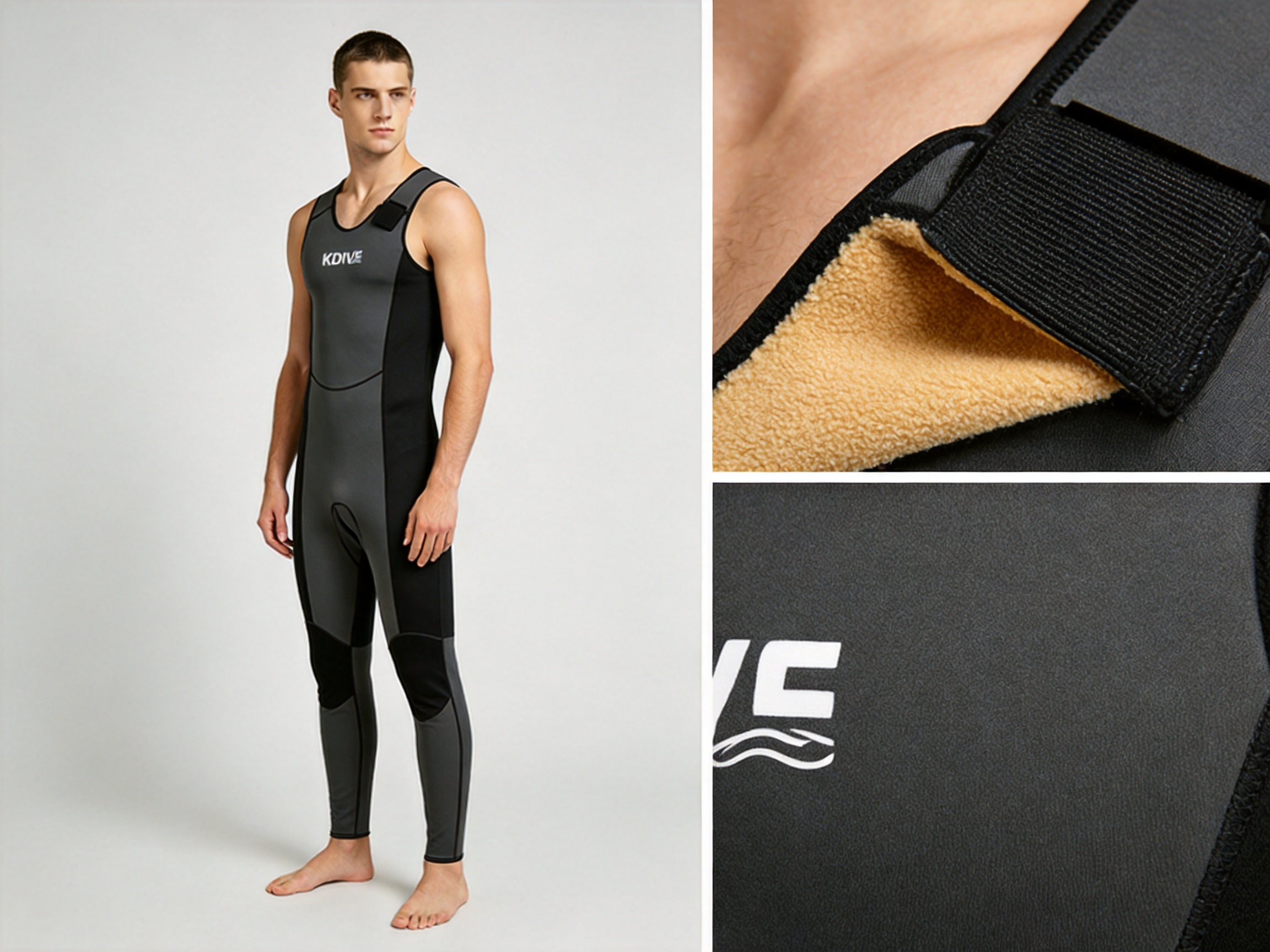
The brushed lining is designed to feel softer against the skin and help retain warmth inside the garment. Its textured surface can create a comfortable micro-layer between the body and the neoprene, reducing the cold sensation that may occur when a wetsuit is first worn.
Because the lining is part of the composite structure, it contributes to comfort during longer water sessions. It can also help the garment feel less clammy than a basic smooth-surface construction. For buyers developing a private-label wetsuit range, the brushed inner lining is an important feature to communicate because it combines user comfort with a clear functional benefit.
3D Athletic Cutting for Active Movement
The wetsuit uses a 3D athletic cutting concept based on the natural curves and movement patterns of the human body. Rather than treating the garment as a flat tube, panel placement follows the shape of the torso, hips, legs, and joints. This approach helps the wetsuit remain close to the body while reducing unnecessary fabric movement.
A closer fit can reduce water circulation inside the suit. When a loose garment allows large amounts of water to move repeatedly between the body and the material, the wearer may lose warmth more quickly. A well-shaped fit helps minimize this effect while preserving the stretch needed for sports performance.
The sleeveless configuration is particularly useful for activities requiring repeated arm movement. Sailing involves steering, line handling, balancing, and reaching. Diving requires equipment management, swimming, and controlled movement through the water. Kayaking and paddle sports involve continuous shoulder rotation. Removing the sleeves reduces fabric around the upper arms and shoulders, helping users move more freely.
The long-leg design retains coverage where it is most useful. The thighs, knees, calves, hips, and lower torso are protected from cool water, contact with equipment, and surface abrasion. This combination makes the garment more versatile than a short-leg suit while keeping the upper body comparatively light and unrestricted.
Close Fit Without Excessive Tightness
A performance wetsuit must fit closely, but an excessively tight garment can become uncomfortable and limit breathing or movement. The high-stretch construction helps the wetsuit conform to the body without depending entirely on rigid compression. This is especially valuable during long sessions, when comfort can influence how long a user remains active.
The adjustable shoulder straps further improve fit flexibility. Users can alter the strap position to accommodate differences in torso length, body shape, and layering preferences. The strap system also makes it easier to put on and remove the garment compared with a fixed-shoulder design.
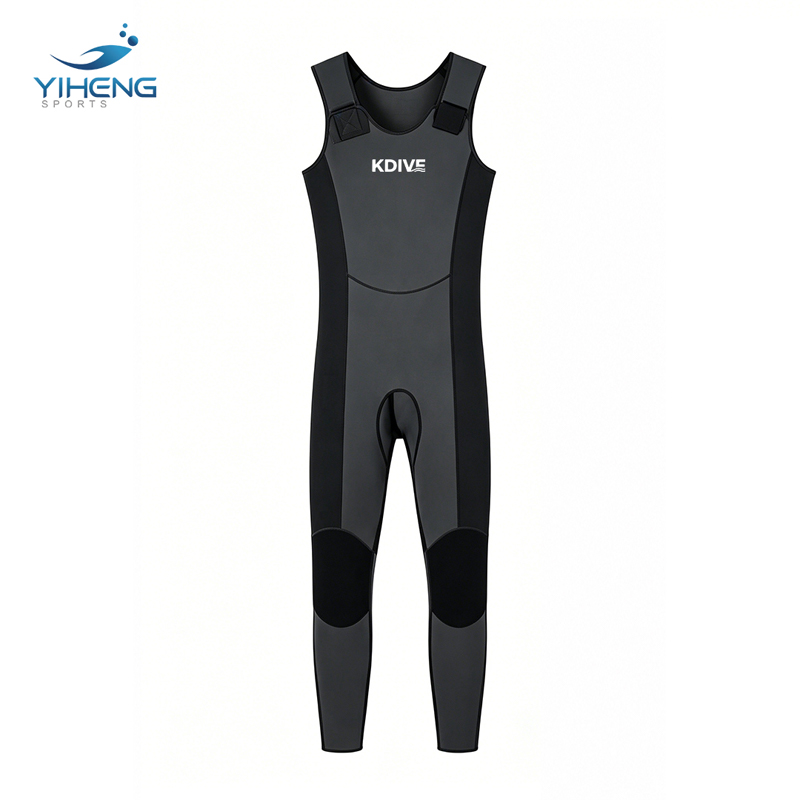
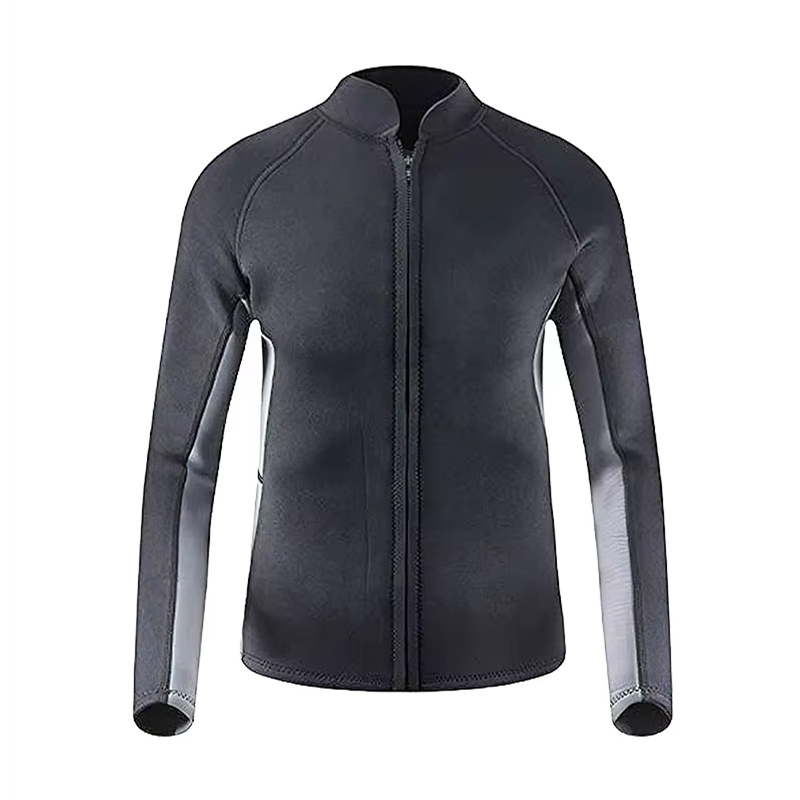
Men's 2mm Neoprene Sleeveless Black & Grey Long John Wetsuit for Sailing & Diving
Thermal Protection for Nearshore Water Activities
Water conducts heat away from the body much faster than air. Even when the weather feels warm, immersion or repeated splashing can cause discomfort if the body is not adequately protected. A wetsuit does not eliminate heat loss, but it helps manage the interaction between the body, water, and surrounding air.
The three-layer construction addresses this challenge in several ways. The outer fabric forms the first barrier against water and wind. The neoprene core slows heat transfer and contributes a degree of buoyancy. The brushed lining improves warmth retention and provides a more comfortable contact surface.
The 2mm thickness is intended for situations where flexibility and lightness are important. A thick winter wetsuit may provide greater insulation in colder conditions, but it can also add weight, bulk, and resistance to movement. The 2mm design offers a more balanced solution for sailing, diving, and water sports in relatively moderate or nearshore environments.
Thermal performance also depends on fit. A suit that is too loose may allow excessive water exchange, while a suit that is too tight may create discomfort and fatigue. The athletic cut, elastic materials, and adjustable straps work together to support a secure fit across a broad range of users.
Suitable Use Environments
This product can be considered for recreational sailing, coastal boating, light diving, training, kayaking, stand-up paddleboarding, canoeing, open-water exercise, and general water recreation. It can also function as part of a layered system when used with a rash guard, jacket, or other protective equipment.
As with all wetsuits, final suitability depends on water temperature, air temperature, wind, activity intensity, personal tolerance, and the rest of the user’s equipment. A 2mm suit is not intended to replace a specialized thick cold-water diving suit in severe conditions. Its advantage lies in versatility, mobility, and moderate thermal protection.
Reinforcement for High-Wear Areas
Water sports garments are exposed to more than water. Users frequently sit on boat seats, kneel on boards, climb over hulls, handle equipment, and move across sand, docks, rocks, or gravel. Knees and hips receive particularly high levels of friction, making them important areas for reinforcement.
This wetsuit uses Ottoman reinforcement on both knees and hips. Ottoman fabric is recognized for its ribbed or structured surface, which can provide added resistance to rubbing and repeated contact. By placing this reinforcement where abrasion is most likely, the design improves practical durability without adding heavy material across the entire garment.
Knee Protection
The knees are repeatedly flexed during paddling, kneeling, boarding, and equipment handling. They may also contact deck surfaces, boat interiors, and rough ground. Reinforcement helps protect the underlying neoprene from premature thinning, scuffing, and surface damage.
For users who alternate between standing and kneeling, reinforced knees can contribute to a longer service life. For commercial buyers, improved wear resistance may reduce warranty issues and increase customer satisfaction because the product remains functional and presentable through repeated use.
Hip Protection
The hips often contact boat seats, kayak cockpits, harnesses, and other equipment. They also experience friction when users climb into or out of watercraft. Ottoman panels in this area provide additional protection while supporting the structure of the garment.
Strategic reinforcement is a more efficient approach than making the entire suit excessively thick. It preserves flexibility in areas that need to stretch while strengthening the locations most likely to experience abrasion.
Four-Needle Six-Thread Stitching
Seam construction is one of the most important factors in wetsuit performance. Even high-quality materials can underperform if seams are weak, uneven, or poorly sealed. This long john wetsuit uses a four-needle six-thread stitching process to create tight and sturdy seams.
The stitching configuration is designed to improve seam strength and support a flatter, more secure construction. Closely controlled seams can reduce the pathways through which water may enter and help the garment maintain its shape during repeated stretching.
For active users, seams are exposed to continuous tension. Every time the wearer bends a knee, rotates a hip, pulls on a shoulder strap, or stretches the torso, the seam experiences mechanical stress. Strong multi-thread stitching helps distribute this stress along the seam rather than concentrating it in a single thread line.
From a manufacturing perspective, four-needle six-thread stitching requires appropriate equipment, trained operators, consistent thread management, and quality control. The process is not simply a decorative detail. It is part of the garment’s structural engineering and contributes to durability, comfort, and water resistance.
Comfort Through Seam Quality
Well-constructed seams can also improve comfort. Uneven or bulky seams may rub against the skin or create pressure points under equipment. A stable, carefully finished seam is less likely to shift or twist during movement.
This is particularly important in a sleeveless long john wetsuit because the wearer may combine it with a vest, jacket, harness, life jacket, or other equipment. A smoother and more secure construction helps reduce interference between the wetsuit and outer gear.
Adjustable Shoulder Strap System
The shoulder straps use hook-and-loop fasteners to provide adjustable positioning. This feature supports easier entry and exit, while also allowing the wearer to personalize the fit around the upper torso.
Traditional fixed-shoulder designs may fit well only within a narrow range of body proportions. Adjustable straps provide more flexibility for users with different torso lengths and shoulder widths. They can also be loosened when putting on the wetsuit and tightened once the garment is correctly positioned.
The fastening system is practical for group use, rental operations, product demonstrations, and retail customers who may not have professional assistance when selecting a size. It also supports layering, as the user may wear a thin base layer or rash guard beneath the wetsuit depending on conditions.
Practical Dressing and Removal
Putting on a wetsuit can be challenging when the material is thick or the opening is limited. The sleeveless silhouette and adjustable straps make this design comparatively straightforward to enter. Once the legs and torso are positioned, the user can adjust the shoulders without forcing the arms through tight sleeves.
The same advantage applies when removing the garment after a long water session. The user can release the hook-and-loop straps and lower the upper section without dealing with restrictive sleeves. This can be particularly helpful in cold, windy, or wet changing areas.
Advantages Compared with Conventional Alternatives
The value of this wetsuit becomes clearer when compared with common alternatives. A standard swimsuit offers minimal insulation and little protection from abrasion. A thin rash guard can protect the skin from sunlight and minor friction but does not provide the same thermal barrier as neoprene. A full-sleeve wetsuit may offer greater upper-body coverage but can restrict shoulder movement or feel warmer than necessary during high-intensity activity.
This product occupies a practical middle position. Its 2mm neoprene provides more insulation than lightweight fabric alone, while the sleeveless design supports greater freedom than a full-sleeve suit. The long-leg form provides more lower-body coverage than shorty wetsuits. Reinforced knees and hips improve durability compared with basic unreinforced constructions.
| Alternative Garment | Typical Limitation | Long John Wetsuit Advantage |
|---|---|---|
| Standard swimwear | Limited insulation and abrasion protection | 2mm neoprene and reinforced contact areas provide broader protection |
| Light rash guard | Primarily protects against sun and minor friction | Three-layer construction adds thermal retention and cushioning |
| Shorty wetsuit | Less coverage on the legs and lower body | Long-leg design offers more protection while retaining arm mobility |
| Full-sleeve wetsuit | May feel more restrictive around the shoulders and arms | Sleeveless construction supports greater upper-limb freedom |
| Heavy cold-water suit | More bulk and potentially reduced mobility | 2mm profile offers a lighter option for moderate conditions |
| Basic single-layer neoprene suit | May provide less comfort and thermal retention | Outer stretch fabric and brushed lining create a multi-layer system |
The product is not intended to replace every other type of water sports garment. Instead, it is designed for users who need a flexible and adaptable wetsuit for moderate conditions and active movement. Its commercial strength is its balanced specification rather than an extreme focus on only one performance characteristic.
Applications in Sailing and Diving
Sailing
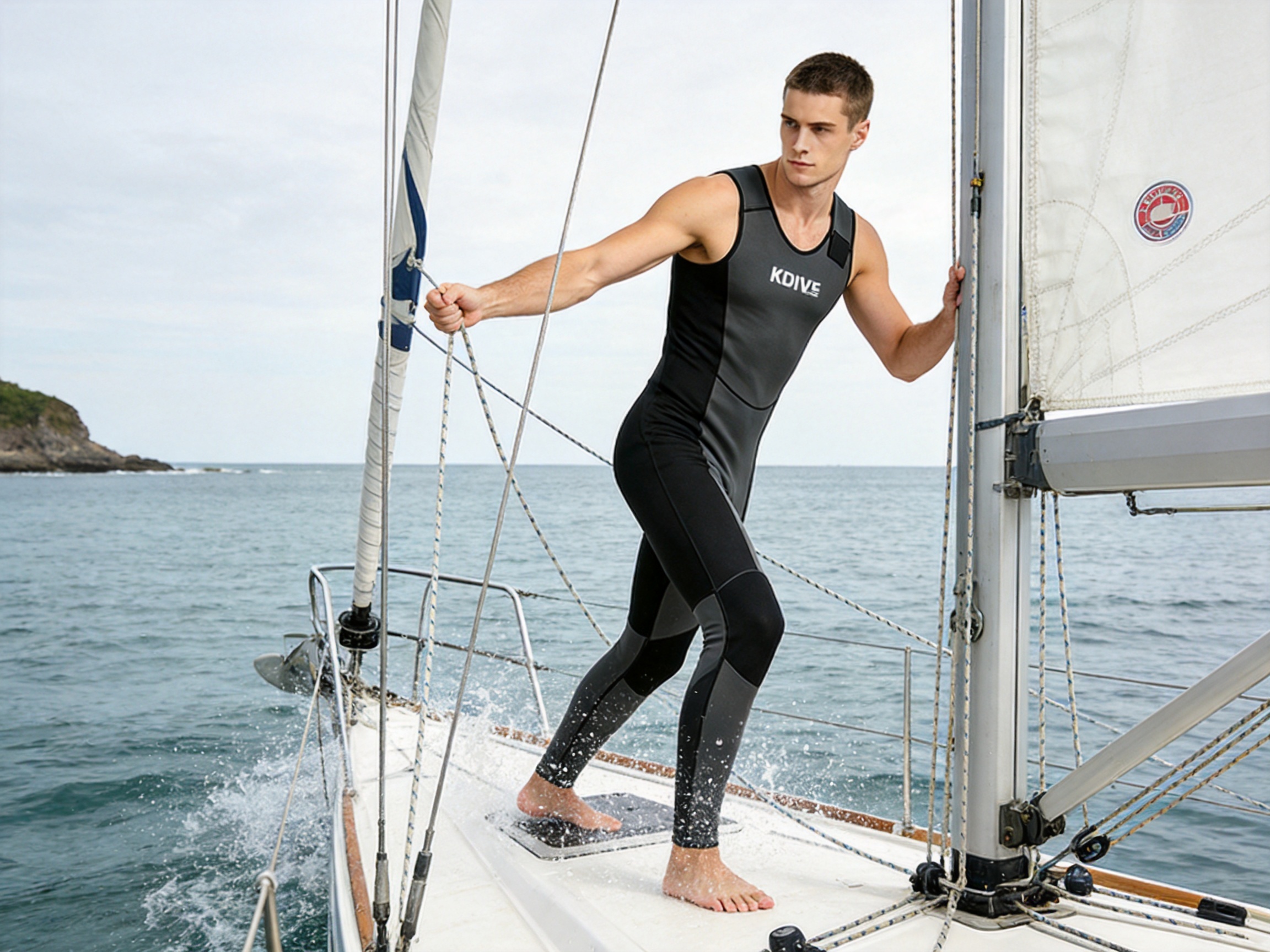
Sailing requires continuous interaction with the boat. Users may sit, kneel, stand, lean, pull lines, adjust sails, steer, and move rapidly across the deck. The wetsuit’s sleeveless construction leaves the shoulders free for these actions, while the long legs protect the lower body from cool spray and contact with boat surfaces.
The reinforced hips can be useful for sailors who spend time seated against a cockpit edge or boat seat. Reinforced knees support sailors who kneel while handling lines or moving through confined areas. The stretch fabric helps the suit follow changes in posture without pulling uncomfortably across the torso.
Diving
For suitable moderate-water diving applications, the 2mm construction provides a light thermal layer that can be worn independently or as part of a broader equipment system. The close fit helps minimize water movement, while the sleeveless form leaves the arms available for swimming and equipment operation.
Divers should always select exposure protection according to actual water conditions and follow appropriate safety practices. In colder environments, a thicker suit or additional layers may be required. The product’s main diving advantage is its combination of flexibility, ease of movement, and moderate insulation.
Kayaking and Paddle Sports
Kayakers and paddleboard users often perform repeated torso rotations and shoulder movements. A restrictive upper garment can lead to fatigue, especially during long sessions. The sleeveless cut reduces bulk around the arms and supports a more natural paddling motion.
The reinforced hip area can also be beneficial in kayak cockpits, where repeated contact may gradually wear ordinary neoprene. The brushed lining adds comfort when the garment is worn for extended periods.
Training and Recreational Use
Water sports schools, clubs, rental companies, and recreational users can benefit from a design that is simple to adjust and suitable for multiple activities. Adjustable straps make fitting easier, while the black and grey color scheme provides a professional appearance for group programs and equipment collections.
For branded programs, the chest logo option creates an opportunity to integrate the wetsuit with a club identity, event campaign, resort uniform, or private-label product range.
Manufacturing Expertise Behind the Product
Jiangsu Yiheng Sports Products Co., Ltd. is a specialist manufacturer focused on neoprene materials and finished water sports products. The company began its business journey in 2008 and has developed its capabilities through continuous experience in raw materials, semi-finished goods, finished products, and market-oriented product development.
With more than 18 years of industry experience in neoprene fabrics and finished products, the company understands both the technical side of material production and the practical expectations of end users. Its experience includes more than 15 years of solid manufacturing practice and eight years of direct retail-market experience.
This combination is valuable for buyers. A factory that understands only production may overlook packaging, positioning, customer use, and retail requirements. A company with practical market experience can better connect material choices and construction details with the expectations of distributors, brands, and consumers.
Factory Scale and Professional Workforce
The company’s factory covers more than 15,000 square meters and employs over 120 professional workers. This scale supports organized production, material handling, product assembly, quality inspection, and order coordination.
A structured factory environment is important for wetsuit manufacturing because the product involves multiple materials and specialized operations. Neoprene, stretch fabrics, linings, reinforcement panels, thread, straps, hook-and-loop components, labels, and logos must be coordinated accurately. Consistent production depends on suitable workspaces, trained staff, defined processes, and controlled inspection.
Material and Finished-Product Knowledge
Yiheng’s product range includes wetsuits, drysuits, fishing waders, rash guards, water sports equipment, and neoprene fabrics. This broad product scope gives the company experience across different performance requirements.
Wetsuits require thermal flexibility and body fit. Drysuits require attention to protective sealing and garment construction. Fishing waders demand durability and practical coverage. Rash guards require lightweight comfort and stretch. Neoprene fabrics provide the material foundation for many of these products. Experience across these categories can support more informed product development and material selection.
OEM, ODM, and Private-Label Support
The long john wetsuit can be supplied as a standard product or adapted for customers requiring private-label development. Custom chest logos are available, creating a straightforward branding option for companies that want to add their own identity without creating an entirely new pattern.
OEM manufacturing is suitable for buyers who already have specifications, artwork, measurements, materials, or packaging requirements. The manufacturer can produce according to an approved design while supporting the practical coordination of materials and production.
ODM development is suitable for buyers who need assistance developing a product concept. A buyer may specify the target market, intended activity, color direction, thickness, fit preference, logo position, and price range. The manufacturer can then help translate these commercial goals into a workable product structure.
Branding Possibilities
The available chest logo option can be used for private-label wetsuits, sports clubs, diving centers, sailing schools, outdoor retailers, water parks, resort programs, and promotional campaigns. Branding may help buyers create product recognition and distinguish their collection from generic garments.
For larger orders, customers may also discuss color combinations, logo artwork, labels, packaging, size grading, and related accessories. The final possibilities depend on order specifications, production feasibility, and quality approval procedures.
Market-Oriented Product Development
Direct retail-market experience helps the company understand the importance of appearance, comfort, ease of use, durability, and customer communication. These factors influence purchasing decisions as much as material specifications.
For example, the black and grey color scheme offers a commercially versatile appearance. Adjustable shoulder straps are easy to explain to customers and provide a visible practical benefit. Knee and hip reinforcements communicate durability. The brushed lining conveys comfort. Together, these features create a product that can be presented clearly in catalogs, online stores, and distributor materials.
Production Process Considerations
Although individual production arrangements may vary according to order requirements, a professional neoprene garment manufacturing process generally includes several controlled stages. These stages help maintain consistency from material preparation to final packing.
Material Selection and Inspection
The first stage involves selecting suitable neoprene, outer fabric, lining, reinforcement material, thread, straps, and fastening components. The materials must be compatible in terms of stretch, thickness, color, handling, and intended use.
Inspection helps identify visible defects, inconsistent surfaces, color variation, dimensional problems, or other issues before cutting. Early inspection is important because a defect discovered after assembly may require more extensive rework or reduce production efficiency.
Pattern Development and Panel Cutting
The 3D athletic cut is translated into patterns and panels. Each panel must be sized and shaped accurately so that the finished garment follows the intended body contour. Cutting accuracy affects fit, seam alignment, stretch behavior, and overall appearance.
Panel-cut construction also allows specific functions to be assigned to specific zones. Stretch materials can be placed where mobility is most important, while Ottoman reinforcement can be positioned at the knees and hips. This approach avoids applying heavy or rigid material to areas where it might reduce comfort.
Panel Assembly
After cutting, the panels are assembled in a controlled sequence. Operators must align edges, match color sections, position reinforcement panels, and maintain the intended shape. The black and grey splicing requires attention to visual alignment so that the finished garment appears clean and balanced.
Specialized Stitching
The four-needle six-thread stitching process is applied to create strong and stable seams. Operators need to control seam allowance, thread tension, feeding speed, and panel alignment. Consistency is especially important in stretch garments because uneven seams may affect both appearance and performance.
Strap and Branding Application
Adjustable shoulder straps and hook-and-loop fasteners are attached after the main body structure has been assembled or at the appropriate intermediate stage. The strap position must be checked so that the garment can be adjusted comfortably and remains balanced when worn.
Custom chest logos are applied according to the approved branding method and artwork. Logo placement, scale, color, and adhesion or stitching quality should be checked to ensure that the finished product represents the buyer’s brand accurately.
Final Inspection
Final inspection may include checking dimensions, seam appearance, reinforcement placement, strap operation, logo quality, color consistency, and overall workmanship. The garment should also be examined for loose threads, surface damage, misalignment, or other visible defects.
For export and private-label orders, buyers may request specific inspection standards, measurement tolerances, packaging requirements, carton markings, or sample approval procedures. Clear communication before production helps reduce misunderstandings and supports consistent order fulfillment.
Quality and Durability Benefits
The product’s durability is supported by several complementary design decisions rather than by a single feature. CR neoprene provides the flexible core. The outer fabric protects and stretches. The brushed lining improves comfort. Ottoman panels protect high-wear areas. Multi-thread seams support structural integrity. Adjustable straps reduce fitting stress during dressing and use.
This layered approach can extend the practical service life of the wetsuit when the garment is used and maintained appropriately. It also gives buyers multiple product benefits to communicate in their sales materials.
Durability should always be considered alongside care. Wetsuits should generally be rinsed with fresh water after exposure to salt water, chlorine, sand, or dirt. They should be dried away from intense direct heat and stored without sharp folds or compression. Proper care helps preserve neoprene elasticity, lining condition, seam performance, and color appearance.
Care Recommendations for End Users
Rinse the wetsuit thoroughly with clean water after each use, especially after sailing or diving in salt water. Gently remove sand and debris from the surface and fastening areas. Avoid aggressive scrubbing, solvents, bleach, and high-temperature washing unless specifically approved by the care instructions.
Allow the garment to dry naturally in a ventilated area. Excessive heat from radiators, dryers, or hot vehicle interiors may damage neoprene and adhesives. Hanging the suit from a suitable broad support can help reduce sharp creases, although the garment should not be stretched excessively while wet.
Inspect the seams, straps, hook-and-loop fasteners, and reinforcement panels regularly. Early attention to loose threads or minor damage can help prevent more extensive deterioration.
Why This Product Suits Private-Label Buyers
Private-label buyers need a product that is practical for users, straightforward to explain, and adaptable to a brand identity. This wetsuit meets those requirements through a balanced specification and available customization.
From a product-development perspective, the 2mm thickness provides a clear market position. It can be presented as a lightweight, flexible wetsuit for moderate conditions and active sports. The sleeveless cut provides an obvious differentiation point. The long-leg design communicates greater coverage than a shorty suit. Reinforced knees and hips demonstrate attention to durability. The brushed lining supports a comfort-focused sales message.
From a branding perspective, the chest logo option allows a buyer to place its identity in a visible but practical location. The black and grey base can support a wide range of brand styles, from technical outdoor collections to sailing clubs and recreational water sports programs.
From a supply perspective, working with a manufacturer experienced in neoprene fabrics and finished products may simplify communication across materials, pattern development, production, and future product expansion. Buyers can potentially develop related items such as drysuits, fishing waders, rash guards, or additional water sports apparel through the same manufacturing partner.
Product Positioning for Different Markets
Outdoor and Water Sports Retail
Retailers can position the wetsuit as a versatile entry-level or mid-range garment for customers who need moderate insulation without the bulk of a full cold-water suit. The design is suitable for customers participating in more than one activity, including sailing, paddling, recreational diving, and coastal exploration.
Sailing Clubs and Training Centers
Sailing clubs and training centers may value the adjustable fit and durable reinforcement. A custom chest logo can create a consistent appearance for instructors, teams, or participants. The sleeveless structure allows instructors and students to move easily while handling lines and equipment.
Diving and Watersports Schools
Diving schools and watersports centers can use the garment as part of a layered exposure-protection system or for moderate-temperature training environments. The adjustable straps simplify fitting among users with different body proportions, although appropriate sizing and hygiene procedures remain essential for shared equipment.
Resorts and Promotional Programs
Resorts, coastal activity providers, and promotional programs can use private-label branding to create a unified product identity. The black and grey appearance is practical for repeated use and can coordinate with other staff or equipment colors.
Buyer Considerations Before Ordering
Wholesale and private-label buyers should confirm the intended market, water-temperature range, size range, logo requirements, packaging, order quantity, and delivery schedule before placing an order. A clear technical specification helps the manufacturer provide accurate recommendations.
Buyers should also decide whether the standard black and grey color combination is suitable or whether a customized colorway is preferred. If branding is required, artwork should be supplied in an appropriate format and approved through a production sample or digital confirmation process.
Size grading is another important consideration. A wetsuit should fit closely but should not create dangerous restriction or excessive discomfort. Buyers targeting different international markets may need to review measurement charts, body-shape expectations, and labeling requirements.
It is also useful to clarify the desired application. A garment intended primarily for sailing may have different priorities from one intended for diving, fishing, or commercial rental. The manufacturer can better evaluate material, reinforcement, logo, and packaging requirements when the end use is clearly described.
Frequently Asked Questions
What activities is this wetsuit designed for?
The wetsuit is designed for sailing, diving, kayaking, paddle sports, recreational swimming, and other moderate-condition water activities. Its sleeveless construction supports arm movement, while the long-leg design provides lower-body coverage.
What does the 2mm thickness mean?
The 2mm specification refers to the approximate thickness of the CR neoprene layer. It provides moderate insulation while keeping the garment relatively lightweight and flexible. Actual comfort depends on water temperature, weather, activity intensity, fit, and individual tolerance.
Is this wetsuit suitable for very cold water?
The product is intended for moderate or nearshore conditions rather than severe cold-water exposure. Users in very cold environments may require a thicker wetsuit, additional layers, specialized diving equipment, or professional exposure-protection guidance.
Why is the wetsuit sleeveless?
The sleeveless design reduces material around the shoulders and upper arms. This supports a wider range of movement for sailing, paddling, swimming, and equipment handling. It also makes the garment easier to put on and remove than many full-sleeve alternatives.
Does the wetsuit provide full lower-body coverage?
Yes. The long john design extends down the legs, providing more lower-body coverage than a shorty wetsuit while retaining an open-arm upper section.
What is the purpose of the brushed lining?
The brushed lining creates a softer contact surface and helps retain warmth inside the suit. It improves comfort during extended use and contributes to the multi-layer thermal-insulation structure.
What are Ottoman reinforcements?
Ottoman reinforcements are structured fabric panels with a ribbed or textured surface. In this wetsuit, they are placed on the knees and hips to help resist friction from boat surfaces, equipment, gravel, and other high-wear contact points.
How do adjustable shoulder straps improve the fit?
The hook-and-loop shoulder straps can be adjusted for different torso lengths and body shapes. They also make dressing and removal easier and can accommodate a thin layer worn underneath the wetsuit.
What is the benefit of four-needle six-thread stitching?
This stitching process creates tight, stable seams designed to support durability, reduce water penetration, and maintain garment structure during repeated stretching and movement.
Can a buyer add a custom logo?
Yes. A custom logo can be added to the chest. This option is suitable for private-label brands, sailing clubs, diving centers, retailers, teams, and bulk export orders.
Can the product be customized beyond the logo?
Depending on the order and development requirements, buyers may discuss colors, labels, packaging, size grading, materials, and other specifications with the manufacturer. Final customization options should be confirmed during product development.
Who manufactures this wetsuit?
The product is manufactured by Jiangsu Yiheng Sports Products Co., Ltd., a China-based specialist in neoprene materials and finished water sports products. The company provides OEM manufacturing, ODM development, private-label support, and long-term supply services.
How much manufacturing experience does the company have?
The company began its entrepreneurial journey in 2008 and has more than 18 years of experience in neoprene fabrics and finished products. Its stated capabilities include a factory of more than 15,000 square meters and a workforce of over 120 professional employees.
What other products does the manufacturer produce?
The company’s product range includes wetsuits, drysuits, fishing waders, rash guards, water sports equipment, and neoprene fabrics. This product breadth supports material and finished-garment development across several water sports categories.
How should the wetsuit be cared for?
Rinse it with fresh water after use, remove sand and salt, allow it to dry naturally in a ventilated area, and avoid excessive heat, harsh chemicals, and sharp folds. Regular inspection of seams, straps, and reinforcement areas is also recommended.
Conclusion
The Men’s 2mm Neoprene Sleeveless Black and Grey Long John Wetsuit is designed to deliver a balanced combination of mobility, moderate thermal protection, comfort, and durability. Its three-layer composite material pairs a super-stretch outer fabric with 2mm CR neoprene and a warm brushed lining. The result is a lightweight garment that supports active movement while helping reduce heat loss during suitable nearshore water activities.
The 3D athletic cut follows natural body movement, and the sleeveless long john silhouette offers a useful compromise between freedom and coverage. Adjustable shoulder straps improve fit flexibility and simplify dressing. Ottoman reinforcements on the knees and hips address common abrasion points, while four-needle six-thread stitching supports seam strength and water resistance.
For commercial buyers, the product also offers strong private-label potential. The black and grey design is versatile, custom chest logos are available, and the manufacturer can support OEM manufacturing, ODM development, and bulk export programs. Jiangsu Yiheng Sports Products Co., Ltd. brings more than 18 years of experience in neoprene fabrics and finished products, supported by a factory exceeding 15,000 square meters and a professional workforce of more than 120 employees.
For sailors, divers, paddlers, water sports retailers, clubs, and private-label brands, this wetsuit provides a practical foundation for a versatile water sports product line. Its greatest strength is the way its features work together: flexible materials support movement, neoprene and brushed lining support warmth, reinforced panels support durability, and specialized manufacturing processes support dependable construction.
References
1. Product specification information for Men’s 2mm Neoprene Sleeveless Black and Grey Long John Wetsuit for Sailing and Diving.
2. Technical information supplied for CR neoprene, super-stretch outer fabric, brushed lining, Ottoman reinforcement, and multi-layer wetsuit construction.
3. Manufacturing information supplied by Jiangsu Yiheng Sports Products Co., Ltd.
4. General principles of wetsuit design, neoprene thermal insulation, athletic garment patterning, and water sports apparel construction.
5. General product-care practices for neoprene garments, including freshwater rinsing, natural drying, and protection from excessive heat and chemical exposure.
Product: Men's 2mm Neoprene Sleeveless Black & Grey Long John Wetsuit for Sailing & Diving

LET’S DEVELOP YOUR NEXT NEOPRENE PRODUCT LINE
Quick Links
Product Categories
Contact Us
-
 Email: postmaster@yihengsport.com
-
 Mobile: +86-13564100539
-
 No. 480 Jiangping Road, Madian, Binjiang Town, Taixing City, Taizhou City, Jiangsu Province, China.
Copyright © Jiangsu Yiheng Sports Products Co., Ltd. All Rights Reserved
China Wetsuit Manufacturer Neoprene Fabric Manufacturer
